


“I do not understand my own actions because I do not do what I want to. But I do the very thing that I hate. … I can will what is right but I cannot do it. For I do not do the good that I want, but the evil I do not want is what I do. Now, if I do what I do not want, it is no longer I who does it but the sin that dwells within me. … O Wretched man that I am. Who will rescue me from this body of death, from this life of sin? Thanks be to God through Jesus Christ our Lord”—St. Paul to the Romans
St. Paul, like the rest of us, wasn’t perfect. He was tempted by sin and at times obviously gave in to that temptation. He understood that God looks for obedience and not perfection. That when we fail that we have a loving Savior that we could turn to: Christ Jesus.
We should be encouraged by St. Paul’s words and not hold our failures against ourselves but to turn to Christ and ask for forgiveness and then move on never looking back at those failures. Remember the words of St. John: “If we confess our sins, He (Christ Jesus) is faithful and just to forgive us our sins and to cleanse us from all unrighteousness” (1John 1:9).
May The Peace of Christ Be With You
Tuesday, February 23, 2010
Saturday, February 20, 2010
Facing Temptation

When Jesus entered the wilderness, He entered into a land that was basically a desert. The temperature in the region was tropical in nature and barren of any real vegetation except for the few trees and shrubs that bordered the Jordan River. For the most part the population was poor, sparse, and destitute of the culture that reigned in Jerusalem but was home to many wild creatures such as vipers, porcupines, jackals, wild boars, ibexes, and panthers.
Jesus was led to by the Holy Spirit, according to tradition, to a mountain top north of Jericho, about a two hours journey from where He was baptized by John. For forty days He fasted and communed with the Father in prayer. But during those days He was also put to the test by Satan in the form of temptation.
The season of Lent is designed to remind us of those forty days that Jesus spent in the wilderness. It is not only a time of prayer and reflection, but a time of repentance, which means we will be challenge by temptation.
When it comes to temptation the most important thing that we should understand is that God is not the source of enticing us to sin. The Apostle James clearly condemns this type of attitude; “Let no man say when he is tempted “I am tempted by God”; for God cannot be tempted by evil, nor does He Himself tempt anyone” (James 1:13).
So where does the source of our temptation originate? Believe it or not, the temptations that each one of us faces are tailor made to cater to our individual desires. In other words, they originate within ourselves: “But each one is tempted when he is drawn away by his own desires and enticed” (vs. 14).
People today don’t like to here or believe that Satan and his horde of fallen angels have anything to do with our sin but they do. They know how to arouse our inner desires and will exploit them in their attempt to lure us away from God. They know that “when desire has conceived, it gives birth to sin; and sin, when it is full-grown, brings forth death” (vs.15).
In order not to be ensnared by the enemies tricks it becomes extremely important to we avoid those things, places or people where we knowingly will face temptation. It is also important that we engage in prayer so we might not fall into temptation just as Jesus advised His disciples to do on the Mount of Olives on the night He was betrayed (Luke 22:40). Another valuable tool in overcoming temptation is the use of Scripture: “Thy Word I have hidden in my heart, that I might not sin against You” (Psalms 119:11). And it was Scripture that Jesus used when He resisted Satan's temptations in the wilderness.
In order for us to fully comprehend how the enemy uses our inward desires against us and how we can overcome those enticements we can look at Christ’s experience in the wilderness.
Satan knew that Jesus was hungry at the end of His forty day fast so He used it as an attempt to entice Him to sin: “If you are the Son of God, command that these stones become bread.” Jesus answered, “It is written, man shall not live by bread alone, but by every word that proceeds from the mouth of God” (Deut. 8:3).
Having failed in his first attempt Satan took Jesus up to the Holy City and sat Him on the pinnacle of the temple, saying, “If you are the Son of God, throw yourself down. For it is written: “He shall give His angels charge over you, and, in their hands they shall bear you up, lest you dash your foot against a stone” (Psalm 91:11-12). To which Jesus replied, “It is written again, you shall not tempt the Lord your God” (Deut. 6:16).
Then Satan took Jesus up on a very high mountain top and showed Him all the kingdoms of the world and their glory and then said to Him, “All these things I will give you if you will fall down and worship me.” Jesus answered him, saying, “Away with you, Satan! For it is written, you shall worship the Lord your God, and Him only shall you serve” (Deut. 6:13).
Many times in my own life I have focused on the fact that Christ Jesus may have been tempted and easily resisted because He was Divinity in human form and God cannot sin. But that point of view is completely wrong. Scripture reveals unto us that Christ Jesus was tempted just like we are, and even suffered because of those temptations, but yet did not sin (Hebrews 2:18; 4:15-16). Christ therefore can sympathize with us during our times of temptation. He knows the pressure we experience and therefore provides us with these comforting words from St. Paul: “No temptation has overtaken you but such as is common to man; and God is faithful, who will not allow you to be tempted beyond what you are able; but with the temptation will provide the way of escape also, that you may be able to endure it” (I Corinthians 10:13).
While no two people are exactly alike, the temptations confronting each of us are basically the same as those that confront others. Therefore we can help and learn from one another. But keep in mind that God makes no promise to help anyone overcome temptation until one repents of his or her sin. To repent means to confess our sin and then turn from it. It means going forth in life to no longer commit intentional habitual sin.
It is important to remember that breaking sinful habits take commitment and great effort on our part. That God does not look for perfection, merely obedience. He knows we will stumble and fall at times, but will be there to pick us up when we do.
May The Peace of Christ Be With You

Thursday, February 18, 2010
The One Called Satan
After he was baptized in the Jordan by John Jesus set off on a forty day journey into the wilderness where he stayed among the wild beasts and was tempted by the devil. Jesus’ encounter with Satan wasn’t merely a metaphor but an encounter with a real individual.
Many people today, even those who profess to be Christians, have a tendency to downplay, even deny, Satan’s existence. Although they will admit that evil exists in the world, they refuse to believe that one who is known as the devil or Satan is a real individual. Most of this disbelief can be attributed to the way that Satan has been depicted over the centuries.
Satan isn’t some red guy in a suit with a pointed tail and pitchfork but a fallen angel that was created by God after the order of angels which means when he was created he wasn’t the evil one that he has become (Psalm 148:2,5; Colossians 1:16; Ezekiel 28:12-15).
During this season of Lent I believe it is important to stop for a moment and reflect on the enemy of God so that we may know who we are dealing with in our own wilderness journey.
Satan is a positive character; meaning he wears disguises and his objectives lie in only one direction. He is no doubt two-faced but never doubly minded, undecided, vague, or feeble in his purpose, desire, or ends. There has never been any irresolution, hesitancy, or aimless action undertaken by him in his war against God. Satan has character and character is felt. He is not merely an influence as so many want to claim. Christ Jesus didn’t deal with mere influences when He encountered demon-possessed people. In dealing with them Christ made a clear distinction between the human personality who was possessed and the personality of the demon who possessed them. In his view they were two distinct individuals and they were personal beings. Christ both spoke and commanded them as individuals—real living deities. And in turn they professed to know Him, confessed His divinity, bowed to His authority, and unwillingly obeyed His commands.
Satan is a master chameleon as well as deceiver. He can become any color or thing that he needs to become in order to pull off the lie. Since he is angelic, he is not limited by space and time, flesh and blood, such as we are and therefore we cannot compete or outsmart him. Satan possesses and wields great power but his power and authority is limited and control by God. This power however is greater than we alone can exercise.
Satan’s greatest desire’s is to be worshipped by all of humanity and therefore goes to great lengths in his attempts to achieve this goal. He is constantly grooming diabolical helpers along the way; many of these are of human origin. He is capable of appearing as an “angel of light” and therefore has his own false version of Christianity. He has his own phony doctrine (1Timothy 4:1), counterfeit communion table (1Corinthians 10:21), counterfeit spirituality (Galatians 3:2-3), based upon a counterfeit gospel (Galatians 1:11-12), his own synagogue (Revelation 3:9), his own dwelling place and throne (Revelation 2:13), and finally, his own false apostles, deceitful workers, false ministers, and false prophetesses (2 Corinthians 11:13,15; Revelation 2:20).
Satan’s human helpers are transformed into ministers of righteousness; propagating doctrines of death and destruction that are so subtle they go for the most part unnoticed. Some of these doctrines have been introduced slowly, slyly, in a way not to shock or alarm anyone and some have been around for decades, even centuries. These false workers of righteousness claim their doctrines come from the God of light; but in reality they are spiritual cyanide. It is extremely difficult for many professing Christians to believe that Satan can use a preacher, evangelist, deacon, priest, or other clergy. That by what they proclaim they become a tool of Satan; for they proclaim another gospel, a gospel different than the truth presented by Paul or the other apostles concerning the truth of Christ Jesus. Yet, this can be and is the case in many areas of Christianity.
Satan is a prince (Ephesians 2:2; John 12:31; Luke 11:14-23), the god of this age (2Corinthians 4:4), who commands a great army composed of both spiritual and fleshly forces. Those of flesh and blood help him advance his kingdom by working knowingly or unknowingly on his behalf—these individuals are not evil, they merely do evil. These are the ones scripture refers to as “the sons of the wicked one” (Matthew 13:38), “ministers of Satan” (2Corinthians 11:5), and “children of the devil” (1John 3:10). The ranks of his spiritual forces clearly outlined in Ephesians 6:12 are the forces he utilizes to gather information and implement his will. Through both his demonic followers and his human agents his will is implemented through a system of thought known as the world. The “world” in this context is a way of thinking that dominates the life of humanity.
Last but not least is the fact that Satan and his unseen forces posses great powers and are capable of assuming visible form (Matthew 4; Luke 4); cause blindness (Matthew 12:22); paralysis (Acts 8:7); convulsions (Luke 9:39); induce self-destructive or bizarre behavior (Luke 8:27; Matthew 7:15); compel animals to destroy themselves (Matthew 8:28-34); create powerful illusions (Exodus 7:11-12); and perform signs and wonders (Matthew 24:24; 2Thessalonians 2:9). These demonic spirits have the power and capability to directly influence our health, moods, imaginations, and thoughts. And no one is beyond his sphere of influence for he managed to infiltrate the sacred circle of Christ’s apostles. He caused St. Peter to stagger (Luke 22:31-32), and then possessed Judas Iscariot moving him to betray Christ and finally commit suicide. Therefore no one should make the mistake of minimizing Satan’s power or deny the reality of his kingdom of evil. However one must also avoid the error of giving into despair—he cannot go beyond the limits imposed upon him by God.
May The Peace of Christ Be With You
Many people today, even those who profess to be Christians, have a tendency to downplay, even deny, Satan’s existence. Although they will admit that evil exists in the world, they refuse to believe that one who is known as the devil or Satan is a real individual. Most of this disbelief can be attributed to the way that Satan has been depicted over the centuries.
Satan isn’t some red guy in a suit with a pointed tail and pitchfork but a fallen angel that was created by God after the order of angels which means when he was created he wasn’t the evil one that he has become (Psalm 148:2,5; Colossians 1:16; Ezekiel 28:12-15).
During this season of Lent I believe it is important to stop for a moment and reflect on the enemy of God so that we may know who we are dealing with in our own wilderness journey.
Satan is a positive character; meaning he wears disguises and his objectives lie in only one direction. He is no doubt two-faced but never doubly minded, undecided, vague, or feeble in his purpose, desire, or ends. There has never been any irresolution, hesitancy, or aimless action undertaken by him in his war against God. Satan has character and character is felt. He is not merely an influence as so many want to claim. Christ Jesus didn’t deal with mere influences when He encountered demon-possessed people. In dealing with them Christ made a clear distinction between the human personality who was possessed and the personality of the demon who possessed them. In his view they were two distinct individuals and they were personal beings. Christ both spoke and commanded them as individuals—real living deities. And in turn they professed to know Him, confessed His divinity, bowed to His authority, and unwillingly obeyed His commands.
Satan is a master chameleon as well as deceiver. He can become any color or thing that he needs to become in order to pull off the lie. Since he is angelic, he is not limited by space and time, flesh and blood, such as we are and therefore we cannot compete or outsmart him. Satan possesses and wields great power but his power and authority is limited and control by God. This power however is greater than we alone can exercise.
Satan’s greatest desire’s is to be worshipped by all of humanity and therefore goes to great lengths in his attempts to achieve this goal. He is constantly grooming diabolical helpers along the way; many of these are of human origin. He is capable of appearing as an “angel of light” and therefore has his own false version of Christianity. He has his own phony doctrine (1Timothy 4:1), counterfeit communion table (1Corinthians 10:21), counterfeit spirituality (Galatians 3:2-3), based upon a counterfeit gospel (Galatians 1:11-12), his own synagogue (Revelation 3:9), his own dwelling place and throne (Revelation 2:13), and finally, his own false apostles, deceitful workers, false ministers, and false prophetesses (2 Corinthians 11:13,15; Revelation 2:20).
Satan’s human helpers are transformed into ministers of righteousness; propagating doctrines of death and destruction that are so subtle they go for the most part unnoticed. Some of these doctrines have been introduced slowly, slyly, in a way not to shock or alarm anyone and some have been around for decades, even centuries. These false workers of righteousness claim their doctrines come from the God of light; but in reality they are spiritual cyanide. It is extremely difficult for many professing Christians to believe that Satan can use a preacher, evangelist, deacon, priest, or other clergy. That by what they proclaim they become a tool of Satan; for they proclaim another gospel, a gospel different than the truth presented by Paul or the other apostles concerning the truth of Christ Jesus. Yet, this can be and is the case in many areas of Christianity.
Satan is a prince (Ephesians 2:2; John 12:31; Luke 11:14-23), the god of this age (2Corinthians 4:4), who commands a great army composed of both spiritual and fleshly forces. Those of flesh and blood help him advance his kingdom by working knowingly or unknowingly on his behalf—these individuals are not evil, they merely do evil. These are the ones scripture refers to as “the sons of the wicked one” (Matthew 13:38), “ministers of Satan” (2Corinthians 11:5), and “children of the devil” (1John 3:10). The ranks of his spiritual forces clearly outlined in Ephesians 6:12 are the forces he utilizes to gather information and implement his will. Through both his demonic followers and his human agents his will is implemented through a system of thought known as the world. The “world” in this context is a way of thinking that dominates the life of humanity.
Last but not least is the fact that Satan and his unseen forces posses great powers and are capable of assuming visible form (Matthew 4; Luke 4); cause blindness (Matthew 12:22); paralysis (Acts 8:7); convulsions (Luke 9:39); induce self-destructive or bizarre behavior (Luke 8:27; Matthew 7:15); compel animals to destroy themselves (Matthew 8:28-34); create powerful illusions (Exodus 7:11-12); and perform signs and wonders (Matthew 24:24; 2Thessalonians 2:9). These demonic spirits have the power and capability to directly influence our health, moods, imaginations, and thoughts. And no one is beyond his sphere of influence for he managed to infiltrate the sacred circle of Christ’s apostles. He caused St. Peter to stagger (Luke 22:31-32), and then possessed Judas Iscariot moving him to betray Christ and finally commit suicide. Therefore no one should make the mistake of minimizing Satan’s power or deny the reality of his kingdom of evil. However one must also avoid the error of giving into despair—he cannot go beyond the limits imposed upon him by God.
May The Peace of Christ Be With You
Wednesday, February 17, 2010
Turn away from sin and be faithful to the Gospel
Today is Ash Wednesday, the beginning of Lent. The mere mention of the word Lent will immediately turn ones thoughts to giving up something one really enjoys like a favorite desert such as ice cream, candy, cake, soda, or some other trivial item. While it may be beneficial in some ways to give up such items, it is not in the true spirit of Lent.
Lent begins a forty day journey that is intended for all of us to take a deeper look inside and find something that we do on a regular basis that offends God. In other words, some sinful habit and root it out. Many professing Christians may give up the items that I mentioned above but will not turn away from the works of the flesh such as gossip, jealousy, hatred, anger, selfish ambitions or lying just to mention a few. They will continue to walk in mortal sin but believe they are pleasing God by abstaining from some trivial item.
We need to remember that after Jesus was baptized in the Jordan by John, he set off on a forty day journey into the wilderness where he stayed among the wild beasts and was tempted by the devil. We all have our wild beasts that we must contend with in life. That beast may come in the form of a person or some sinful habit that the devil uses in an attempt to destroy our relationship with God. If we use this Lenten season to concentrate on dealing with that person, place, or thing, and learn to rely upon the Holy Spirit for strength, we too will emerge victorious from the wilderness.
When he emerged from the wilderness he went to Galilee, preaching the gospel of the Kingdom of God, saying, “The time is fulfilled, and the Kingdom of God is at hand. Repent, and believe in the good news” (Mark 1:15).
May the Peace of Christ Be With You
Lent begins a forty day journey that is intended for all of us to take a deeper look inside and find something that we do on a regular basis that offends God. In other words, some sinful habit and root it out. Many professing Christians may give up the items that I mentioned above but will not turn away from the works of the flesh such as gossip, jealousy, hatred, anger, selfish ambitions or lying just to mention a few. They will continue to walk in mortal sin but believe they are pleasing God by abstaining from some trivial item.
We need to remember that after Jesus was baptized in the Jordan by John, he set off on a forty day journey into the wilderness where he stayed among the wild beasts and was tempted by the devil. We all have our wild beasts that we must contend with in life. That beast may come in the form of a person or some sinful habit that the devil uses in an attempt to destroy our relationship with God. If we use this Lenten season to concentrate on dealing with that person, place, or thing, and learn to rely upon the Holy Spirit for strength, we too will emerge victorious from the wilderness.
When he emerged from the wilderness he went to Galilee, preaching the gospel of the Kingdom of God, saying, “The time is fulfilled, and the Kingdom of God is at hand. Repent, and believe in the good news” (Mark 1:15).
May the Peace of Christ Be With You
Sunday, May 10, 2009
ENCOUNTERING CHRIST ON THE ROAD TO JERUSALEM
The Mediterranean sun was growing longer and softer in the late afternoon as a gentle breeze blew through the nearby palm trees cooling down the hot dusty road. The fords of the Jordan River had been passed for the final time and now only the “City of Palms” lay ahead.
The “City of Palms”: The ancient city called Jericho. But it wasn’t the original nor did it occupy the sight of that hamlet. This was a newly constructed city about a half-hours travel to the northwest of the original location. The area possessed a climate tropical in nature and at times grew very hot. It was long known as an oasis because of its fresh water spring, which contributed to its nickname. Here palm trees of various kinds grew alongside sycamores, cypress flowers, and myro-balsamum, which yielded precious oil. Not only was Jericho an oasis but it was also a gathering place for pilgrims on the final leg of their journey to Jerusalem to celebrate the annual Passover feast. Jericho was only fifteen miles from the Holy City. A mere six hours travel by foot. And the main road of travel ran right through town.
Now it was customary at the time, when a well-known teacher was on a journey passing through town that the people would gather around and listen to his teachings. With Passover just a few days away many such teachers were passing through the city and many of the people that gathered about these teachers were pilgrims themselves on the way to Jerusalem; they were the ones with an added advantage. Others however, even though the Law demanded they travel to Jerusalem to attend the festivities, were unable to do so for various reasons. In lieu of this, many of these unfortunate souls would gather along the streets to see some of the famous rabbis and hear their teaching as they journeyed along.
On any particular day as the sun began to peak over the nearby mountains farmers would began driving their animals through the city streets as merchants began setting up shop and children desiring to get an early start could be heard laughing and screaming as they ran trough the streets.
Bartimaeus was awakened by all the early-morning noise of the city. Inside his makeshift living quarters he clutched his ever-present coat, throwing it around his shoulders as he struggled to his feet. With matted hair and unshaven face, this unkempt, blind beggar, began making his way to “beggars row” on the outskirts of town.
As he crept along the city streets, he stopped only long enough to beg for a small portion of stale bread from a sympathetic shopkeeper. With gift in hand he continued on his journey through the long city streets. As he walked along, most of the townsfolk that caught sight of him quickly diverted their attention in another direction. Beggars were considered a public nuisance.
Bartimaeus had always lived a dreadful life. From the very beginning he had two strikes against him. First there was the fact that he hardly had his own identity. The prefix” Bar” means “son of” and “Timaeus” means the “blind kid.” So he was merely identified as the blind son of another. Secondly, he experienced very little joy in life, little success, or peace. His daily goal was mere survival. But surviving really wasn’t living. He survived on charity, on people’s leftovers. Most of which was granted by those pious individuals who were familiar with God’s word: “Prayer and fasting is good, but better than both is almsgiving with righteousness…for almsgiving saves from death and purges away every sin. Those who give alms will enjoy a full life” (Tobit 12:8-9; cf. 4:8-11; 14:10-11; Sirach 3:30; 7:10; 29:12).
When he finally reached his spot on “beggar’s row,” Bartimaus sat down in his usual spot amongst his friends and fellow outcasts. On a normal day their spirits hung low, but today there was a reason to be a little more cheerful; they knew that Passover was coming and the crowds in the streets would be much larger than usual. So there was hope that this day would be more profitable than the others.
As the streets began to line with people, Bartimaeus began to think that perhaps this would be a red-letter day. But unbeknownst to him down the long dusty road trod the most famous Rabbi of all—Jesus of Nazareth. Jesus was traveling with his motley band of twelve apostles, followed by a huge crowd. Their journey had been long; they were hot and sweaty and dust from the road clung to their wet skin. But with the afternoon sun fading, relief from the day’s heat was on its way. There was also relief in store for Bartimaeus also. This poor blind beggar had lived a life without any visual contact with his environment and he had sat in the hot, blazing sun all his life, but today relief from life’s torments would finally come.
Anticipation hung heavily in the air as the burgeoning crowd began to approach the city. The mood was festive; many no doubt were quite hopeful that they would encounter the great healer and teacher from Nazareth. One man in particular began to circulate among the people in hopes of catching a glimpse of this famous rabbi. He was a rich man, the chief tax collector of the city. His name was Zacchaeus.
As Zacchaeus looked for a vantage point, Bartimaeus sat along the road unable to see, but he heard the sounds of young children running ahead of the crowd, laughing, yelling, and playing as young children do. Then slowly, a rising crescendo of voices and laughter accompanied some playing reeds and flutes were heard. With his sense of hearing being keenly developed due to the lack of his sight, Bartimaeus could tell that something or someone had caused a mammoth crowd to assemble, a much larger crowd than usual.
Desiring to know who or what was causing all the commotion, he turned to a fellow beggar and asked, “Hey, what’s all the commotion about?” His companion could no more get a grip on things as he could, so he replied in a puzzled tone of voice, “I don’t know.” Determined to have the inquiries answered they turned to the passing crowd, “What’s all the commotion?”
The “City of Palms”: The ancient city called Jericho. But it wasn’t the original nor did it occupy the sight of that hamlet. This was a newly constructed city about a half-hours travel to the northwest of the original location. The area possessed a climate tropical in nature and at times grew very hot. It was long known as an oasis because of its fresh water spring, which contributed to its nickname. Here palm trees of various kinds grew alongside sycamores, cypress flowers, and myro-balsamum, which yielded precious oil. Not only was Jericho an oasis but it was also a gathering place for pilgrims on the final leg of their journey to Jerusalem to celebrate the annual Passover feast. Jericho was only fifteen miles from the Holy City. A mere six hours travel by foot. And the main road of travel ran right through town.
Now it was customary at the time, when a well-known teacher was on a journey passing through town that the people would gather around and listen to his teachings. With Passover just a few days away many such teachers were passing through the city and many of the people that gathered about these teachers were pilgrims themselves on the way to Jerusalem; they were the ones with an added advantage. Others however, even though the Law demanded they travel to Jerusalem to attend the festivities, were unable to do so for various reasons. In lieu of this, many of these unfortunate souls would gather along the streets to see some of the famous rabbis and hear their teaching as they journeyed along.
On any particular day as the sun began to peak over the nearby mountains farmers would began driving their animals through the city streets as merchants began setting up shop and children desiring to get an early start could be heard laughing and screaming as they ran trough the streets.
Bartimaeus was awakened by all the early-morning noise of the city. Inside his makeshift living quarters he clutched his ever-present coat, throwing it around his shoulders as he struggled to his feet. With matted hair and unshaven face, this unkempt, blind beggar, began making his way to “beggars row” on the outskirts of town.
As he crept along the city streets, he stopped only long enough to beg for a small portion of stale bread from a sympathetic shopkeeper. With gift in hand he continued on his journey through the long city streets. As he walked along, most of the townsfolk that caught sight of him quickly diverted their attention in another direction. Beggars were considered a public nuisance.
Bartimaeus had always lived a dreadful life. From the very beginning he had two strikes against him. First there was the fact that he hardly had his own identity. The prefix” Bar” means “son of” and “Timaeus” means the “blind kid.” So he was merely identified as the blind son of another. Secondly, he experienced very little joy in life, little success, or peace. His daily goal was mere survival. But surviving really wasn’t living. He survived on charity, on people’s leftovers. Most of which was granted by those pious individuals who were familiar with God’s word: “Prayer and fasting is good, but better than both is almsgiving with righteousness…for almsgiving saves from death and purges away every sin. Those who give alms will enjoy a full life” (Tobit 12:8-9; cf. 4:8-11; 14:10-11; Sirach 3:30; 7:10; 29:12).
When he finally reached his spot on “beggar’s row,” Bartimaus sat down in his usual spot amongst his friends and fellow outcasts. On a normal day their spirits hung low, but today there was a reason to be a little more cheerful; they knew that Passover was coming and the crowds in the streets would be much larger than usual. So there was hope that this day would be more profitable than the others.
As the streets began to line with people, Bartimaeus began to think that perhaps this would be a red-letter day. But unbeknownst to him down the long dusty road trod the most famous Rabbi of all—Jesus of Nazareth. Jesus was traveling with his motley band of twelve apostles, followed by a huge crowd. Their journey had been long; they were hot and sweaty and dust from the road clung to their wet skin. But with the afternoon sun fading, relief from the day’s heat was on its way. There was also relief in store for Bartimaeus also. This poor blind beggar had lived a life without any visual contact with his environment and he had sat in the hot, blazing sun all his life, but today relief from life’s torments would finally come.
Anticipation hung heavily in the air as the burgeoning crowd began to approach the city. The mood was festive; many no doubt were quite hopeful that they would encounter the great healer and teacher from Nazareth. One man in particular began to circulate among the people in hopes of catching a glimpse of this famous rabbi. He was a rich man, the chief tax collector of the city. His name was Zacchaeus.
As Zacchaeus looked for a vantage point, Bartimaeus sat along the road unable to see, but he heard the sounds of young children running ahead of the crowd, laughing, yelling, and playing as young children do. Then slowly, a rising crescendo of voices and laughter accompanied some playing reeds and flutes were heard. With his sense of hearing being keenly developed due to the lack of his sight, Bartimaeus could tell that something or someone had caused a mammoth crowd to assemble, a much larger crowd than usual.
Desiring to know who or what was causing all the commotion, he turned to a fellow beggar and asked, “Hey, what’s all the commotion about?” His companion could no more get a grip on things as he could, so he replied in a puzzled tone of voice, “I don’t know.” Determined to have the inquiries answered they turned to the passing crowd, “What’s all the commotion?”
“It’s Jesus of Nazareth. He’s coming down the road.” A passer-by informed them. “You mean the great rabbi? The fellow they claim can heal the sick and blind?” Bartimaeus excitedly asked. “That’s the one,” came the reply, “and I’m not going to miss seeing him for anything.” With that the unknown stranger was off and running.
Bartimaeus had been desperately looking for Jesus. So as the crowd grew closer and closer, excitement filled his heart. “I can’t believe it,” shouted Bartimaeus to his friend. “This could be the greatest day of my life if I can only get his attention.”
“Hey Bart there he is, I can see him!” exclaimed his companion. “But how are you ever going to get his attention?”
“I don’t know, but this is it,” stated Bartimaeus. “I may never get another chance to come in contact with Jesus again. I want to be healed.” So throwing dignity and caution to the wind Bartimaeus yelled at the top of his voice, “Jesus, Son of David, have mercy on me!”
“Be silent beggar!” came a retort from the crowd. “You’re making too much noise. And besides there’s so many people here you don’t stand a chance on seeing Jesus. So just relax and keep quite!” But Bartimaeus was more determined now than ever to get Jesus’ attention. “What do they know?” he thought to himself. He knew he couldn’t see, but he could yell louder.
Did you catch the irony in all this? These were religious people on their way to religious festival who were listening to Jesus teach about the kingdom of God. Here were people listening to Jesus and taking it all in, they were in the right place, listening to the right thing, but completely missed the point! When it came to helping out a blind man, they told him to shut up. They basically said to him, “We’re on our way to the Holy City; we have no time for a blind beggar! Don’t bother the Master, you old beggar man. He’s got more important things to do than fool with you!”
Some folks are known to pat themselves on the back because they attend Mass on Sunday. Now, I’m glad they attend weekly Mass, but just attending Mass on Sunday doesn’t matter a whole lot if what you or I do afterwards doesn’t reflect the fact that we have just met with Jesus. Again, here were people traveling with Jesus, listening and taking in all His teachings, but when it came to helping out a blind man they told him to shut up! They failed to seize a golden opportunity that fairly smacked them in the face. They were like so many in the Church today, interested in listening but woefully short when it comes to obedience. They told Bartimaeus that Jesus had no time for him. But that’s where they were wrong, dead wrong! Jesus was far more concerned with the hurting and the needy than his day-planner, schedule or his persona.
Bartimaeus would not remain silent; you could hear his voice rise above the noise of the crowd. It rang out like a great clarion call. “Jesus, O Lord, Son of David, have mercy on me!”
Suddenly the crowd stopped, because Jesus had stopped. A great hush fell over the crowd. Throughout his ministry winds and waves couldn’t stop him nor could angry mobs or crowds of people. But a lone cry from a blind beggar could. Jesus with his great heart of compassion demanded that Bartimaeus be brought before him.
“Be silent now,” came a soothing voice. “Rise to you feet beggar and come, Jesus is asking for you.”
Jesus, on his way to becoming the Savior of the world, stops to become the servant of a blind beggar! Notice the complete difference between Jesus’ attitude and that of the people. The fickle crowd had been saying, “Shut up!” But now their refrain changes as they say effectively, “Cheer up, take courage.” How many times had Bartimaeus heard that before with no real reason to cheer up, offered merely as a panacea in the place of really offering help. But this time there was a real reason to cheer up, to take courage, for someone was there who could make a real difference!
The Lord always stands still at the cry of those who call Him. To Him each and every soul is valuable, regardless of color, race, state of origin, or position. He doesn’t look at names or titles, but at the heart of the seeker. All of humanity is in need of Him—without exception. And until they meet Him they are blind in need of sight. They may not be physically blind but they are spiritually blind. Only the Lord can give the light of life. Only through an encounter, a divine appointment with Him can a soul receive its sight. And only His dwelling in a man’s heart can make it alive and bright.
Bartimaeus was told that the Master was calling, and when Jesus calls, one dares not stay where they are. Up to his feet he leapt, and following as best he could the sound of the voice, he made his way to Jesus.
“What do you want me to do for you?” Jesus asked. Bartimaeus responded humbly without hesitation, “Lord, that I may receive my sight.”
Then Jesus said to him, “Receive your sight; your faith has made you well.”
Immediately Bartimaeus went from total darkness to unimpaired vision. Why? Because God responds to faith! Jesus didn’t have to ask what Bartimaeus wanted because it was obvious. He asked him to articulate the words of faith, words that acknowledged why Bartimaeus had called for Jesus in the first place. Just think, the very first thing Bartimaeus saw with his new found vision was the face of Jesus. But the story doesn’t end here; from this moment on Bartimaeus tossed his old cloak behind, the cloak that signified darkness and despair, and began to follow the Master. When Jesus changes us, we don’t need the old things anymore. They no longer have any value.
The healing of Bartimaeus is intended to encourage all sinners throughout the ages. Just as Jesus restored sight to this poor wretch, so He is able and willing to open the blind eyes of our souls. But Jesus doesn’t heal all the spiritually blind; only those that desire to receive their sight and cry out to Him. Think about it! When Jesus passes by you, you can stay trapped in your thoughts, reasoning and earthly desires. You can even think about it for as long as you want and doubt if you desire. But if you so choose my friend, you will stay blind forever! If you do not cry out to the Lord your soul will never receive its sight; not only that, but you will never be a partaker in the eternal life to come.
After receiving his sight Bartimaeus joined the procession making its way through Jericho and on to Jerusalem. Considering what it must have been like to have the face of Jesus be the first thing one has ever seen, consider now the things that Bartimaeus would see a few days later as his gentle Healer was scourged, mocked, and crucified.
With the recorded healing of Bartimaeus complete, a question comes to mind. Why do we know his name? Didn’t Jesus heal a number of blind, deaf, and crippled people? Why does this man stand out? It’s hard to know definitely, but tradition holds that Bartimaeus’ name is presented while others are lost due to the fact that he became a leader in the early Church. The faith that caused this man to call out, “Jesus, Son of David, have mercy on me!” was the faith that sustained him, having been delivered by the mercy for which he cried, through the most trying of times, a faith that was bolstered by the event of the resurrection!
Friday, May 8, 2009
THE TEST OF KNOWING CHRIST
Now by this we know that we know Him, if we keep His commandments. For he who says, “I know Him,” and does not keep His commandments, is a liar, and the truth is not in him. But whoever keeps His word, truly the love of God is perfected in him. By this we know that we are in Him. He who says that he abides in Him ought himself also to walk just as He walked (1 John 2:3-6).
Many in our day profess Christianity. Some even go as far as to attend Mass or some other Christian service on a weekly basis, but are nothing more than pew sitters. These individuals may have the world fooled; even their friends and family into believing they are Christians, but are in reality are living dangerously by believing there is nothing wrong with their lifestyle. They believe through their weekly church attendance that they have reached the standard of goodness that is acceptable unto God. Unfortunately their standard of goodness doesn’t begin to compare with God’s standard.
The problem with pretend Christians is that they always have their eyes upon all the wrong things. They refuse to separate themselves from an ungodly world. They use no discernment in what material they read, what movies or television programs they view, what establishments they frequent or what company they keep. They are completely unconcerned with the types of conversations they engage in, how they dress, act, walk or treat other people. Some even believe there is nothing wrong with abortion or sexual activity outside the boundaries set forth by the Church. In other words, they believe they can engage in the activities that God is against and still be considered Christians. But they are gravely mistaken. These are the ones that St. John is referring to as not only living a lie, but whose lives are void of any truth.
Those that profess an allegiance unto Christ must remember His words: "Love the Lord your God with all your heart and with all your soul and with your entire mind and with all your strength.” And: “Love your neighbor as yourself. There is no commandment greater than these." (Mark 12:28-31).
Again, one cannot engage in sinful activity or stand for everything that God is against and love Him with all their heart, soul, mind and strength, nor can one love their neighbor in the way that God has intended. The two are inseparable.
St. John tells us we are “not to love the world or the things in the world. If anyone loves the world, the love of the Father is not in him. For all that is in the world; the lust of the flesh, the lust of the eyes, and the pride of life; is not of the Father, but is of the world. And the world is passing away, and the lusts of it; but he who does the will of God lives forever (1John 2:15-17).
In writing his First Epistle, St. John makes it perfectly clear that the context of his letter is nothing new. It is the same commands that Christ Jesus had already revealed. He merely reinforces the fact that the one who truly knows Christ is the one who keeps His words. By keeping the Lord’s words the love of God becomes perfected in us. Therefore the true mark of knowing Christ Jesus comes down to one word—obedience (1John 2:5).
May The Peace Of Christ Be With You
Many in our day profess Christianity. Some even go as far as to attend Mass or some other Christian service on a weekly basis, but are nothing more than pew sitters. These individuals may have the world fooled; even their friends and family into believing they are Christians, but are in reality are living dangerously by believing there is nothing wrong with their lifestyle. They believe through their weekly church attendance that they have reached the standard of goodness that is acceptable unto God. Unfortunately their standard of goodness doesn’t begin to compare with God’s standard.
The problem with pretend Christians is that they always have their eyes upon all the wrong things. They refuse to separate themselves from an ungodly world. They use no discernment in what material they read, what movies or television programs they view, what establishments they frequent or what company they keep. They are completely unconcerned with the types of conversations they engage in, how they dress, act, walk or treat other people. Some even believe there is nothing wrong with abortion or sexual activity outside the boundaries set forth by the Church. In other words, they believe they can engage in the activities that God is against and still be considered Christians. But they are gravely mistaken. These are the ones that St. John is referring to as not only living a lie, but whose lives are void of any truth.
Those that profess an allegiance unto Christ must remember His words: "Love the Lord your God with all your heart and with all your soul and with your entire mind and with all your strength.” And: “Love your neighbor as yourself. There is no commandment greater than these." (Mark 12:28-31).
Again, one cannot engage in sinful activity or stand for everything that God is against and love Him with all their heart, soul, mind and strength, nor can one love their neighbor in the way that God has intended. The two are inseparable.
St. John tells us we are “not to love the world or the things in the world. If anyone loves the world, the love of the Father is not in him. For all that is in the world; the lust of the flesh, the lust of the eyes, and the pride of life; is not of the Father, but is of the world. And the world is passing away, and the lusts of it; but he who does the will of God lives forever (1John 2:15-17).
In writing his First Epistle, St. John makes it perfectly clear that the context of his letter is nothing new. It is the same commands that Christ Jesus had already revealed. He merely reinforces the fact that the one who truly knows Christ is the one who keeps His words. By keeping the Lord’s words the love of God becomes perfected in us. Therefore the true mark of knowing Christ Jesus comes down to one word—obedience (1John 2:5).
May The Peace Of Christ Be With You
Wednesday, April 8, 2009
JUDGING RIGHT AND WRONG
Does scripture actually tell us that we are not allowed to judge between right and wrong, good and bad, or truth and error? If it does, how are we to obey God’s commands to uphold the truth and stand against wickedness while keeping judgmental attitudes in balance? In order to find out the answers to these questions we must carefully consider the Lord’s words.
In Matthew chapter 7, Jesus said, “Judge not, that you be not judged. For with what judgment you judge, you will be judged; and with the measure you use, it will be measured back to you” (1-2).
By carefully studying Christ’s words we see that He does not prohibit us from judging but instead issues a very strong warning that we will be judged according to the standard we choose. In other words, if one is teaching in error but yet insists on finger pointing at another errant teacher there’s a problem. Likewise, if we judge another when we are committing the same or an equally grave sin, whether openly or in secret, there’s a problem. It becomes a problem because we become a witness against ourselves by committing the same acts.
Those bent on cowering away from a full commitment unto God or those who have something to hide will say that we have no right to judge another’s heart or intentions, but this too is contrary to Christ’s teachings: “Those things which proceed out of the mouth come from the heart, and they defile a man. For out of the heart proceed evil thoughts, murders, adulteries, fornications, thefts, false witness, and blasphemies” (Matthew 15:18-19).
So we see through Christ’s words that we are to question or judge another’s actions and words according to truth. For if we are not permitted to judge it becomes virtually impossible to distinguish between right and wrong. So going against what can be deemed as popular opinion (because no one wants to hear the truth anymore) scripture does in fact command us to judge.
“Now we exhort you, brethren, warn those who are unruly, comfort the fainthearted, uphold the weak, be patient with all. Test all things; hold fast what is good. Abstain from every form of evil” (1 Thessalonians 5:14, 21, 22).
“Beloved, do not believe every spirit, but test the spirits, whether they are of God; because many false prophets have gone out into the world” (1 John 4:1).
“Brethren, if anyone among you wonders from the truth, and someone turns him back, let him know that he who turns a sinner from error of his way will save a soul from death and cover a multitude of sins” (James 5:19-20). So how are we to accomplish these commands if we cannot judge?
Whether or not one wants to believe it, testing is judging between right and wrong. But unfortunately Satan has successfully removed the ability of many professing Christians to measure truth because he has convinced them that it is wrong to judge. Again it is not judging that is wrong it is the standard by which one judges and the motives behind their judgment that can be wrong.
There is a standard for judging correctly and Christ Himself has given it to us: “Do not judge according to appearance, but judge with righteous judgment” (John 7:24). And, “He who rejects Me, and does not receive My words, has that which judges him—the word that I have spoken will judge him in the last day” (John 12:48).
So judgment is not to be according to appearance or personal preference but according to God’s own righteous standard, which is revealed in His word. It is God’s Word that judges between what is right and wrong. We are merely to test all things by evaluating it against that measure. It is the only true measure since God doesn’t change; His word doesn’t change. “Heaven and earth will pass away but my words will never pass away” (Matthew 24:35). Therefore anything that disagrees with Gods unchanging word is not true.
Now according to scripture we can only practice righteous discernment if we are in love with God. If Christ Jesus is at the center of our heart and we keep His word. “If anyone loves Me, he will keep My word; and My Father will love him, and We will come to him and make our home with him. He who does not love Me does not keep My words; and the word which you hear in not mine but the Father’s who sent me” (John 14:23-24).
We may not be able to judge the finality of someone’s salvation, but we can clearly discern whether or not they are abiding in a true relationship with Christ based upon whether or not one is obedient to Christ’ commands. In other words, in today’s world many may claim they love God but it is impossible to love God while aligning ones self against His words, against truth. Some of you may still call this being judgmental but we see that Christ Jesus plainly stated it as truth. Furthermore, only those that profess Christianity but live substandard Christian lives are offended when confronted with the truth. Truth hurts and no one wants to deal with it. One must deal with it here in this lifetime or deal with it in the life to come. But in the life to come it will be too late and the consequences of dealing with it will be more than one can bear.
In Matthew chapter 7, Jesus said, “Judge not, that you be not judged. For with what judgment you judge, you will be judged; and with the measure you use, it will be measured back to you” (1-2).
By carefully studying Christ’s words we see that He does not prohibit us from judging but instead issues a very strong warning that we will be judged according to the standard we choose. In other words, if one is teaching in error but yet insists on finger pointing at another errant teacher there’s a problem. Likewise, if we judge another when we are committing the same or an equally grave sin, whether openly or in secret, there’s a problem. It becomes a problem because we become a witness against ourselves by committing the same acts.
Those bent on cowering away from a full commitment unto God or those who have something to hide will say that we have no right to judge another’s heart or intentions, but this too is contrary to Christ’s teachings: “Those things which proceed out of the mouth come from the heart, and they defile a man. For out of the heart proceed evil thoughts, murders, adulteries, fornications, thefts, false witness, and blasphemies” (Matthew 15:18-19).
So we see through Christ’s words that we are to question or judge another’s actions and words according to truth. For if we are not permitted to judge it becomes virtually impossible to distinguish between right and wrong. So going against what can be deemed as popular opinion (because no one wants to hear the truth anymore) scripture does in fact command us to judge.
“Now we exhort you, brethren, warn those who are unruly, comfort the fainthearted, uphold the weak, be patient with all. Test all things; hold fast what is good. Abstain from every form of evil” (1 Thessalonians 5:14, 21, 22).
“Beloved, do not believe every spirit, but test the spirits, whether they are of God; because many false prophets have gone out into the world” (1 John 4:1).
“Brethren, if anyone among you wonders from the truth, and someone turns him back, let him know that he who turns a sinner from error of his way will save a soul from death and cover a multitude of sins” (James 5:19-20). So how are we to accomplish these commands if we cannot judge?
Whether or not one wants to believe it, testing is judging between right and wrong. But unfortunately Satan has successfully removed the ability of many professing Christians to measure truth because he has convinced them that it is wrong to judge. Again it is not judging that is wrong it is the standard by which one judges and the motives behind their judgment that can be wrong.
There is a standard for judging correctly and Christ Himself has given it to us: “Do not judge according to appearance, but judge with righteous judgment” (John 7:24). And, “He who rejects Me, and does not receive My words, has that which judges him—the word that I have spoken will judge him in the last day” (John 12:48).
So judgment is not to be according to appearance or personal preference but according to God’s own righteous standard, which is revealed in His word. It is God’s Word that judges between what is right and wrong. We are merely to test all things by evaluating it against that measure. It is the only true measure since God doesn’t change; His word doesn’t change. “Heaven and earth will pass away but my words will never pass away” (Matthew 24:35). Therefore anything that disagrees with Gods unchanging word is not true.
Now according to scripture we can only practice righteous discernment if we are in love with God. If Christ Jesus is at the center of our heart and we keep His word. “If anyone loves Me, he will keep My word; and My Father will love him, and We will come to him and make our home with him. He who does not love Me does not keep My words; and the word which you hear in not mine but the Father’s who sent me” (John 14:23-24).
We may not be able to judge the finality of someone’s salvation, but we can clearly discern whether or not they are abiding in a true relationship with Christ based upon whether or not one is obedient to Christ’ commands. In other words, in today’s world many may claim they love God but it is impossible to love God while aligning ones self against His words, against truth. Some of you may still call this being judgmental but we see that Christ Jesus plainly stated it as truth. Furthermore, only those that profess Christianity but live substandard Christian lives are offended when confronted with the truth. Truth hurts and no one wants to deal with it. One must deal with it here in this lifetime or deal with it in the life to come. But in the life to come it will be too late and the consequences of dealing with it will be more than one can bear.
Sunday, March 30, 2008
ENCOUNTERING CHRIST ON THE ROAD TO EMMAUS--PART FIVE
 Saving Faith Verses Religion
There are two types of Catholics, those that are truly Catholic Christians and those that are merely religious worshippers. In other words, there are those who practice religion for whatever reason and then there are those who posses true faith. And believe me when I say there is a real difference.
Religion is humanities creation; faith is Gods gift. A religious person comes to Mass to momentarily ease a guilty conscience and check off a Sunday obligation; while faith comes to Mass to see Christ Jesus. Religion sees Jesus as a meal ticket; faith sees Jesus as God. Religion searches for physical needs to be met by performing religious rituals; while faith on the other hand see rituals as a means of communing with God and receiving grace. Religion sees the signs, but not what the signs point to. But again faith sees Christ Jesus. The Church has this syndrome; worship, hymns, prayers, rituals, sacraments, sermons, creeds, benedictions, and even scripture. But what should be exciting becomes a common place where one cannot see beyond all the commotion in order to see the Word of God made flesh and dwelling among us. Religion is focused on right ritual while faith is focused on a right relationship with God. Religion is caught up in words while faith uses those same words to abide with the object of the words, Christ Jesus. Religion becomes common and mundane, but faith is always fresh and seeks to commune with God.
People who are religious do one of two things; they either wear their religion on the outside with pride and arrogance, like the Pharisees before them where everything was literal and outward in appearance giving the impression that their lives were in order. The other religious type is the one who hides it. They are the ones that shock you when you find out that they attend church. These people have not made Christ Jesus the center of their lives and they will die in their religion. In John 6, Jesus made it perfectly clear that unless we consume all of Him as the very substance of life, one will die of eternal starvation. When one sees Christ Jesus as the primary substance of life and ingests His life, death, and resurrection as we ingest food to live on, then one has faith, not religion. You see, religion cannot survive death, but faith in Christ Jesus can. Religion will not come out victorious on the other side of trials and tribulations, but faith in Christ is the ultimate victory in any and all circumstances. Religion will meet death with fear and trembling, but faith will cry out, “To live is as Christ, to die is gain!”
“The cup of blessing which we bless, is it not the communion of the blood of Christ? The bread which we break, is it not the communion of the body of Christ?” So asked St. Paul of the Corinthian Christians (1 Corinthians 10:16). It most certainly is! Yet the religious do not believe.
To those who merely attend Mass in order to check off another Sunday obligation cannot believe. For they, like countless other professing Christians who are not in full communion with the Church, see the elements as merely symbolic, meaningless pieces of bread and wine. But does their opinion mean they merely encounter the elements? In their places of worship it is true that the non-Catholic does indeed encounter nothing more than a mere symbol, but is that true within the confines Catholic Church? Certainly not! While non-Catholics and many professing Catholics fail to believe they are encountering the real Christ, His body, blood, soul and divinity under the appearance of bread and wine, doesn’t change the fact that they are indeed these things. They are merely carbon copies of their Pharisaic counterparts of old, who stood toe-to-toe, face-to-face, and nose-to-nose with Jesus, yet failed to accept or believe He was the Messiah.
Whoever comes forward to eat and drink from the Lords table without true faith and belief or fails to purify their soul of sin through the act of confession, reaps not blessing but condemnation. They are guilty of profaning the body and blood of the Lord. Those that do such a thing do not offer the first fruits of self-sacrifice after the manner in which Able offered the first fruits of his flock, become like Cain who offered something second rate and unacceptable to the Lord. In other words, they partake of the Lords table in an unworthy manner, thus eating and drinking judgment unto his or herself like their forefathers who partook unworthily in the early Church found themselves weak, sick, and some even died. Many are wrought with such things today for the very same reasons. The elements of bread and wine are truly the body and blood of the Lord. There is no symbolic intent in St. Paul’s words. In fact there is not a single instance recorded in all of scripture that testifies to anyone reaping the Lords judgment for having profaned a mere symbol (see 1 Corinthians 11:23-30). One cannot “drink the cup of the Lord and the cup of demons; you cannot partake of the Lord’s Table and the table of demons” (10:21).
Is all of this not true? Was there not one false disciple reclining at the table with the Lord at the Last Supper? There most certainly was! And until the proper moment in time had come he was unbeknownst by the other eleven. Judas Iscariot walked alongside the Lord for three years. He witnessed first hand all the miracles that Jesus worked among the sick, dieing, and even the dead and was even commissioned alongside the other eleven who were then sent out to preach the Gospel. He was with them when they received the power to cast out demons, heal the sick, cleanse lepers and raise the dead (see Matthew 10:5-14). Judas was even entrusted to be the keeper of the group’s finances. But despite all of that Jesus referred to him as being a devil (John 6:70) and the “son of perdition” (John 17:12), a term that St. Paul would later use to describe the Antichrist (2 Thessalonians 2:3). And he died after sharing in the bread and wine that Christ consecrated at the Last Supper.
Unfortunately there are many among us today, sitting at the Lord’s Table, who posses the same spirit that controlled the life of Judas Iscariot. But despite that fact and all the unbelief, the Eucharist is still in fact Christ Jesus coming to us veiled under the appearance of bread and wine.
So the question I propose is this: How do you partake of the meal that’s set before you? Do you come with mere religion checking off another Sunday obligation so that the bland taste of bread and the sweet taste of wine leave the taste of condemnation upon your tongue and then go home with one more religious quota satisfied which will soon be washed away with Sunday dinner? Or do you come in faith where the bland taste of the bread will become as sweet as milk and honey as your spirit is stirred reminding you of your sins and the Savior who took them unto Himself and suffered your punishment?
Have you ever wondered why Christ chose to utilized bread and wine to represent His body and blood? I know I did until the late Bishop Fulton Sheen eloquently explained the answer: “First of all, because no two substances in nature better symbolize unity than bread and wine. As bread is made from a multiplicity of grains of wheat, and wine is made from a multiplicity of grapes, so the many who believe are one in Christ. Second, no two substances in nature have to suffer more to become what they are than bread and wine. Wheat has to pass through the rigors of winter, be ground between the Calvary of a meal, and then subjected to purging fire before it can become bread. Grapes in their turn must be subjected to the Gethsemane of a wine press and have their life crushed from them to become wine. Thus do they symbolize the Passion and Sufferings of Christ, and the condition of Salvation, for our Lord said unless we die to ourselves we cannot live in Him. A third reason is that there are no two substances in nature, which have more traditionally nourished man than bread and wine. In bringing these elements to the altar, men are equivalently bringing themselves. When bread and wine are taken or consumed, they are changed into man’s body and blood. But when He took bread and wine, He changed them into Himself” (Life of Christ, Image Books, p.278).
In order for all of us to avoid the trap of falling into mere mundane religion, we need to heed the words of St. Francis De Sales: “From the beginning until the priest goes up to the altar make your preparation with him. This consists in placing yourself in the presence of God, recognizing your unworthiness, and asking pardon for your sins (and mean it from the depths of your heart). (2) From the time he goes up to the altar until the Gospel consider our Lord’s coming and His life in this world by a simple, general consideration. (3) From the Gospel until after the Creed consider our Saviors preaching and affirm that you are resolved to live and die faithful and obedient to His holy word and in union with the holy Catholic Church. (4) From the Gospel to the Our Father apply your heart to the mysteries of the Passion and Death of our Redeemer. They are actually and essentially represented in this Holy Sacrifice. Together with the priest and the rest of the people you will offer them to God the Father for His honor and for your own salvation. (5) From the Our Father to the communion strive to excite a thousand desires in your heart and ardently wish to be joined and united forever to our Savior in everlasting love. (6) From the communion to the end of Mass give thanks to Jesus Christ for His incarnation, life, passion, and death, and for the love He manifests in this Holy Sacrifice. Implore Him always to be merciful to you, your parents, friends, and the whole Church. Humble yourself with all your heart and devoutly receive the blessing our Lord gives you through the ministry of His minister” (Introduction To The Devout Life, Image Books, p. 104-105).
A true relationship with Christ is evidenced in the breaking of the bread and should result in a changed life and behavior. It should make us sensitive to our sins, our faults, and failures. It should make us see them in the light of the tremendous price Christ paid to secure our redemption. As we gather together with our brothers and sisters to celebrate the Eucharistic meal, we should be conscience of our oneness not only with those who partake of the elements with us, but with Christ Himself. The Eucharist is a family meal, and the Lord of the family desires that His children love one another and care for one another. That we should be one in Christ and that oneness should be evident in everything we say or do during Mass and after Mass when we step back out into the world even if others fail to recognize us as such.
I can imagine Cleopas and his friend standing in amazement, perhaps embracing in great joy, asking each other, “Were not our hearts burning within us while He talked with us on the road and opened the scriptures to us?” Their world had finally come together again. With their hearts still ablaze they set off at once for Jerusalem. It matter not that darkness had fallen across the land and traveling at night was extremely dangerous, the joy that Jesus had placed in their hearts through the hearing of His words and the breaking of bread made the danger seem trivial. They were determined to share with the other disciples what had transpired on the road to Emmaus. And that’s the type of attitude that we should have.
May The Peace Of Christ Be With You!
Saturday, March 29, 2008
ENCONTERING CHRIST ON THE ROAD TO EMMAUS—PART FOUR
 The Heart Burning Experience
As the two-hour journey from Jerusalem to Emmaus was coming to a close, they approached the village at which time Jesus acted as if He was continuing on further. God has given the world the greatest and most perilous gift that one can receive—the gift of free will. This gift that has been bestowed upon each of us to either invite Christ into our hearts or allow Him to pass on is the same gift that is offered in the Book of Revelation where we find the Lord saying, “Those to whom I love I rebuke and discipline…here I am! I stand at the door and knock. If anyone hears My voice and opens the door, I will come in and eat with him, and he with Me” (3:19-20).
This was the very situation in the Emmaus story. Jesus had been knocking on the two disciples hearts throughout the journey and now as He acted as if He was going further the two men needed to make a decision to either invite this stranger to stay with them or to allow Him to continue on His way. They elected to invite Him to stay.
The three entered a dwelling where a basic meal was quickly prepared. As the meal was placed upon the table the moment came for Jesus to disclose His true identity. How did He do it? “He took bread, gave thanks, broke it and began to give it to them.” It was through the action of the breaking of the bread that their eyes were opened to the stranger’s true identity. It was an action they had no doubt seen before. They no doubt saw His hands—that they were different from when He had last broken bread before their eyes. They were the nail-pierced hands of the Savior of the world. But it was in the act of the breaking of the bread that resulted in their knowing Him in an instant. And then in another instant, He was gone.
Each time we come to the Lords table, we witness the intimate act of the breaking of the bread. It is through this simple act that God has chosen to open our eyes—the eyes of our mind and the eyes of our heart in order that we may understand what He has done for all of us.
Why did the two disciples not recognize Jesus on the road? Had they not heard Him teach, had they not witnessed the miracles worked by His hands, and had they not heard Him tell them all that as the Messiah He would suffer, die and on the third day rise again? They had indeed. But the two disciples could not recognize Jesus because they had the wrong expectations concerning the Messiah. They had human expectations for fulfilling a divine plan. They had expected Jesus would deliver Israel from the hands of her oppressors as a military and political Messiah. So Jesus had to come to them as a stranger in order to fill in the gaps of their misconceptions.
If the Lords first disciples, who were first hand witnesses, needed to observe the Eucharist in order to recognize the Savior of the world then how much more do we need it? We need it not only to open our eyes so we too can recognize Christ but also to serve as a reminder of what Christ Jesus endured to pay for our sins lest we become so preoccupied with our lives and activities that we fail to commune with Him. The Eucharist is a touching memorial that should fill our hearts with gratitude as we partake of it with other believers. It should bring to our minds those scenes of our Lords suffering portrayed in the Gospels. Christ desires that we remember how He died. He desires that we remember because everything we have as Catholic Christians centers in His death. However, this memorial is not simply the recalling of historical facts.
To Be Continued...
ENCOUNTERING CHRIST ON THE ROAD TO EMMAUS--PART THREE
 The Relevance Of Scripture
As the two disciples spoke of what transpired on the cross, Jesus took hold of their bewilderment and sorrow and gave them a heart filling experience. How? By pointing them unto God’s self-revelation in the scriptures. Luke tells us, “Beginning with Moses and all the prophets, Jesus explained to them what was said in all the scriptures concerning Himself.”
Jesus gave the Emmaus travelers the greatest Old Testament exposition in history. Through His words the shadows and symbols of the Old Testament revelation began to come together. He reminded them that back at the fall of mankind, the apparently victorious Satan, in the form of a serpent, was told that the seed, the offspring of a woman “will crush your head, and you will strike His heel” (Genesis 3:15). And so the story was foretold of the cosmic struggle between life and death, of the pattern of death and resurrection according to Old Testament revelation. It was clearly visible in the life of Abraham when he was willing to sacrifice his only son Isaac, only to get him back again. In the preservation of Joseph so he could become the benefactor of his brothers who tried to destroy him. In the Exodus of the Israelites from Egypt after having been saved from the angel of death through the sign of the blood of the Passover lamb. Jesus recalled His own teaching of how the Israelites escaped physical death in the wilderness from a plague of serpents when they looked trustingly to a great bronze serpent which Moses raised on a pole, pointing out that He too would be lifted up on the cross, “that everyone who believes in Him may have eternal life in Him” (John 3:15).
Jesus no doubt took the now speechless disciples through the Suffering Servant of Jehovah passages in Isaiah and recounted how the nation of Israel was taken into exile and brought back again to rebuild Jerusalem as a symbol of the greater redemption through personal salvation through faith in Him. Throughout His discourse Jesus offered proof that He had fulfilled that, which had been prophesied over the centuries. That the Old Testament anticipations of His passion and triumph of life over death was proof that He was indeed the long awaited Messiah.
The two disciples couldn’t have possibly expected that the sharing of their problem with the stranger on the road to Emmaus would bring them toward a solution. But there was more to it than that. Christ wasn’t merely walking beside them to help them find a solution—He was in the problem itself. Jesus asked His two listeners, “Did not the Christ have to suffer these things?”
The problem for the disciples as it is with many in our time was making sense of the cross, how to accept it. Jesus helped them through that by showing them how the cross itself was the creative act of God. St. Paul would later write that, “God was in Christ reconciling the world unto Himself, not counting men’s sins against them” (2 Corinthians 5:19). The cross of shame and suffering had become the Cross of Redemption for all who would come to Christ in repentance and faith.
The most vital instrument used in the proclamation of the Gospel and evangelization is the use of scripture. As apologist Jeff Cavins once stated, “Catholics must proclaim the Word—what Christ says about our situation, what He is offering us, what He says about the Church and the beauty of the Church.” The underlying problem is however, “Many Catholics don’t know the bible. They don’t know it enough to talk about it. What kind of position does that put one in if we are supposed to be out there changing the world—proclaiming the good news?”
Another problem that arises over the scriptures is the fact that many Catholics that do read and know scripture have not studied apart from proving Catholic doctrine. They have not read scripture in the sense that Pope John Paul II recommended, and that is to read it and allow the Holy Spirit to speak to ones heart. To see what the Holy Spirit has to say to us as individuals.
The written Word of God is the one place we can definitely hear the voice of God. Therefore it is imperative that we pay close attention to the readings at Mass; that we give them our undivided attention. For it is through the proclamation of the Gospel reading that Jesus begins to intrude into our lives, probing our thoughts, for the purpose of blessing us and helping us grow. What matters here is how we respond. Do we, like the two disciples welcome His initiative and let Him minister to us? Do we want Him to keep talking and explaining what previously baffled us? Or do we merely desire that the Gospel proclamation be over because the things He reveals are too uncomfortable as He encroaches into our conscience?
Jesus rebuked Cleopas and his companion when He said, “How foolish you are, and how slow of heart to believe all that the prophets have spoken.” Perhaps the key word is “all.” It wasn’t that they hadn’t read or heard all that had been proclaimed by the prophets of old, but perhaps they had read or heard selectively like so many do today. The passages that spoke of a suffering servant didn’t fit with their expectations of the Messiah, just as many today cannot accept or follow a Messiah that calls us to suffering. Many have a tendency to skip over or ignore such biblical passages that reference to such a thing. If one truly opens his or her mind, spirit, and soul when given an exposition from the scriptures they will react positively, and in fact will want more.
To Be Continued…
Friday, March 28, 2008
ENCONTERING CHRIST ON THE ROAD TO EMMAUS—PART TWO
 A HEART FILLING EXPERIENCE
As the three men walked along Jesus asked the two disciples, “What are you discussing together as you walked along?” Quickly the men realized they were amongst someone who was willing to listen to their sorrows and troubles so they poured out their sad story.
How wonderfully kind and compassionate is our Lord. He could have very well become angry with these two men for their lack of faith in Him. After all hadn’t He said, “Unless a seed dies, it abides alone, but if it dies it bears much fruit?” (John 12:24). But no, Jesus doesn’t berate them but rather as someone once stated, “In His infinite courtesy, Jesus remembered the frailty of over-strained nerves and bewildered minds and came, not too suddenly or overwhelming upon them, but with gracious signs and tokens, and messages from one to the other.”
Cleopas (one of the two disciples) expressed surprise at the stranger’s inquiry so he asked: “Are you the only one living in Jerusalem who doesn’t know the things that have happened there in these days?” Despite the note of incredulity in the voice of Cleopas, Jesus continues patiently and innocently asks, “What things?” To which they eagerly replied, “About Jesus of Nazareth.”
The two men then told the stranger that this Jesus “was a prophet, powerful in the word and deed before God and all the people.” Notice the use of the past tense, which strongly implies that He wasn’t relevant to the present or otherwise they wouldn’t have been in their downcast state of mind. Their experience concerning Jesus was in the past. The cross-had taken Him from them, and their minds hadn’t yet made sense of the changed situation, or adjusted to it. At the time the cross was just a great negative to them.
We’ve all heard exciting stories of what Jesus has done in the past—but what about the present? Too often we get fixated on all the bad that has occurred in our lives to the point that we forget that all of that is history. We must ask ourselves if Jesus is a present, bright reality in our lives today or is He something in the past? Do we recognize what He is doing in our lives; that he is walking beside or with us? Or is He just another stranger on the road?
Life has many distractions—hard work, routine, tiredness, and at times ill health, that can grind us down to the point where we carry on mechanically, never lifting our eyes or minds from the dust of the earthly road we travel. We thus become unaware of the glory and strength of His presence with us. When that occurs life then looses its meaning and leaves us washed out. But this story gives us hope.
Jesus is just as real among us today as He was 2,000 years ago on the road to Emmaus. He is the “unseen stranger” walking with us, listening to us, and if we are willing to listen for His voice, He will reveal Himself to us. He may not reveal Himself to us today as He did in the past. He won’t appear in a burning bush as He did with Moses or an audible voice in the middle of the night, as was the case with Samuel. We aren’t likely to receive a physical heavenly vision, as was the case with Isaiah. But nevertheless He still speaks to those who seek Him. Jesus speaks in the silence of the waiting spirit, forever impressing His will and call upon those who are willing to listen.
The voice of the Holy Spirit speaks to the inner shrine of the heart and it’s the same voice that called Peter, Andrew, James and John away from their fishing nets, Matthew from his tax booth, Zacchaeus out of a tree, and called out from heaven through a blinding light that knocked Paul from his horse. It’s the voice of Christ Himself perpetually calling all of us to “Come out from among them and be separate, says the Lord. Do not touch what is unclean, and I will receive you. I will be a Father to you, and you shall be My sons and daughters, says the Lord God Almighty” (Isaiah 52:11; Ezekiel 20:34, 41; 2 Samuel 7:14; 2 Corinthians 6:17-18).
Have you not heard His voice? If you profess to serve Christ and His Church, it is strange if you have not.
To Be Continued…
Saturday, March 22, 2008
ENCOUNTERING CHRIST ON THE ROAD TO EMMAUS—PART ONE
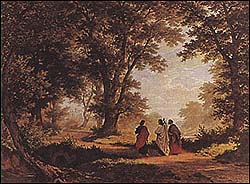 As I look toward the cross alongside thousands of others, I begin to notice that the crowds are breaking up and leaving. After I take one more glance at the cross of Christ I turn to leave but I am immediately confronted with two roads. I notice many are choosing the road to the left, but only a few are choosing the road to the right. As I approach these two roads I notice two men. The first one is dead and is lying beside the road to the left. But the other is alive and is pointing to the road on my right. To my amazement many are asking the dead man for directions. I thought to myself, “Why would anyone ask a dead man for directions when there is one who is alive?”
Every day we make decisions in life simply because we are creatures of variety. We choose what time we get up, what we wear, eat, and what we will do throughout the day. In fact there are many decisions that beg for our attention right now, but there is only one choice that you and I must consciously choose before it’s too late. And that’s to walk the “narrow road.” It is the road to the right, the road to righteous life. This road is one of decision, discipline, and desire. And like the road to Emmaus it will lead us to an encounter with Jesus, the one who is alive.
ON THE ROAD TO EMMAUS:
It was late in the afternoon of the day of resurrection when two disciples were on their way to Emmaus, a little town about seven miles from Jerusalem. The two disciples were discouraged and depressed. The Master they had revered, loved, and followed, had been horribly put to death. A cruel death of the most degrading kind—crucifixion!
Only a week before, on Palm Sunday, the disciple’s hopes had risen to fever pitch when the excited crowds had hailed their Master as the long awaited-deliverer that would set them free from Roman occupation. But now their Master lay dead in a sealed tomb and their hopes were dashed; the dream was over.
Have you ever noticed that some of the saddest words in our language begin with the letter D? For example, there is disappointment, doubt, delusion, defeat, despair, and death. All of which can damper our hopes. Human hope is a fragile thing and when it withers its difficult to revive. Hopelessness is a disease of the human spirit that is desperately hard to cure. When you see someone you love and care for overtaken by illness, which goes on, and on, despair sets in. It almost becomes impossible to hope for recovery, to even be afraid to hope because of not being able to cope with another letdown.
Each of us have no doubt at times felt blind, distant, and even given up all hope. In fact there have probably even been times when we prayed and prayed and received absolutely no help, which resulted in our losing all hope. There were probably even times when we have prayed and our problems seemed to have only worsened. Maybe it was when we prayed for healing for another or ourselves but the sickness only got worse. During these times of despair doesn’t mean that God has left us alone. We only believe that He has since the problems in life have a way of blurring our vision, our understanding, our faith, and our hope. It makes us want to run away from our difficulties rather than stand and face them. But how fortunate we are that we have a God who not only comes looking for us, but also draws near and travels with us each step of the way and helps us to be able to clearly see again. Remember this: God will never abandon His children, but often His children abandon Him over disbelief.
There wasn’t really a reason for the two disciples to be in the state of mind that they were in other than disbelief. For you see, even though they had received the news of the morning, that Mary had found the grave of Jesus empty and had heard the claims of some of the other women that they had seen angels and had even met the risen Jesus, they did not believe those reports.
God accomplishes His greatest work through us by allowing our hopes and dreams to die, only to bring them back again in rather surprising and unique ways. Job lost his family and fortune, but they were eventually restored many times over. God blessed Abraham and Sarah with a son long after nature would have made that impossible. And the hopes of these two disciples had been dashed when Jesus died upon the cross. They did not realize at the time that the cross and all its horrors were a part of Gods sovereign plan to pave the way of salvation for all of humanity.
Many of us may not like our current surroundings or situations, or even the direction that society appears to be going or all the ungodliness that seems to plague the Church, but remember not all is lost. We merely need to wait upon the Lord to redeem our situations and restore our hope. We don’t need to focus on the negative when there are many wonderful things transpiring within our own lives and the Church that overrides all the negative aspects. We just need to stop long enough to take a serious look around.
As the weary disciples made their weary way toward Emmaus a stranger fell in alongside them. What had begun as a very depressing trip soon turned into one of the most wonderful walks in human history! We know this because the stranger was the risen Jesus. But somehow in the beginning they did not recognize Him. In fact Luke tells us “they were kept from recognizing Him.” It wasn’t by accident that they didn’t recognize who He was. No, they weren’t allowed to recognize Jesus for a reason. And the reason was so that they might be in the same position as we are 2,000 years later.
Many times we do not recognize Jesus when He suddenly appears in our midst. Sometimes He appears to us as a stranger who speaks the right words we need to hear for whatever ails us. Other times He may come to us in the form of a beggar, someone who’s hungry, or some other needy person. He may even come to us, as someone in trouble, someone whose marriage just went south, or someone who has lost a child, a spouse, or some other loved one. It may be that He comes to us through someone in need of friendship, a shoulder to cry on, or someone seeking Himself. How we respond during those times will determine our level of commitment unto Him. Do we dare deafen our ears and look the other way, forgetting the times He met our needs? Or do we respond as He did when He met the two blind men on the road to Jericho? These particular blind beggar’s cried out unto Him, “Have mercy on us, O Lord, Son of David!” But the people commanded them to be silent. But that didn’t stop them they merely cried louder and more intense until the Master commanded they be brought before Him. Then He asked one very simple question, “What do you want Me to do for you?” To which they responded, “Lord, that our eyes may be opened” (Matthew 20:29-33).
We may be the only contact that many will ever have with Christ Jesus. I once heard it said, “There are five Gospels, Matthew, Mark, Luke, John, and us. Many will never read the first four, but all will read the last one.” Christ Jesus didn’t commission us to leave this world, or to sit idle in it, but to disciple it.
For far too long Christianity in America has sat idle living in her own little world. For decades the majority of professing Christians have been going in the direction they have desired instead of going in the direction that God desires. They have distorted the scriptures and cheapened the gospel in such a way that humanity has become riddled with confusion, which is why 1.37 million babies are murdered annually in America; why 40 million Americans indulge in Internet pornography; why divorce is rampant and 50 to 70% of all married people will commit adultery this year. It is also why 10,000 people will be murdered this year alone of which over 5,000 will be between the ages of 10 and 24. And it is also why over 30,000 people will see life as no longer worth living and commit suicide and why Americans are confused about the sanctity and institution of marriage being only between a man and a woman.
To barrow the words of Fr. Tom Forrest, I must also say: “If there were ever a time when sinners needed conversion, if there were ever a time when captives needed to be set free and mountains of pain and depression removed, if there were ever a time when the human race needed sanctification and salvation, if there were ever a time when the whole world needed to hear and follow Christ’s teachings on love, mercy, and forgiveness, that time is now!” Whose cry are you willing to hear? Whose eyes are you willing to open?
To Be Continued…
Sunday, March 16, 2008
Escaping The Outer Darkness
Yesterday I went to confession at a different parish, one that's a little closer to home. The line was quite lengthy, but with several priests hearing confessions it moved quite quickly. Now it doesn't matter whether I make my confession face-to-face or in the box. It just happened to be the box when it came to be my turn. When I first entered there was light to show the way, but as I knelt the tiny room became engulfed in darkness.
Now there was nothing new in that experience with the exception of the fact that I noticed it was much darker than the confessional at my own parish. It was so dark I couldn't see my hand in front of my eyes. It was a strange feeling to be in that type of darkness. But I thought how appropriate. It made me think how vital it is that we make regular confessions, more than once or twice a year. For it is from the outer darkness, the land of wailing and nashing of teeth that confession saves us from. Without it we would parish.
The Church teaches that Christ calls us “to conversion and penance, like that of the prophets before Him, His call does not aim at outward works, “sackcloth and ashes,” fasting and mortification, but at the conversion of the heart, interior conversion. Without this, such penances remain sterile and false; however conversion urges expression in visible signs, gestures and works of penance (see Joel 2:12-13; Isaiah 1:16-17; Matthew 6:1-6, 16-18).
Interior repentance is a radical reorientation of our whole life, a return, a conversion unto God with our whole heart. It means an end to all intentional sin, a turning away from evil, with repugnance toward the evil actions we have been committing. But at the same time it entails that we desire a resolution to changing our life with hope in Gods mercy and trust in the help of His grace. This conversion of heart is accompanied by a salutary pain and sadness which the Father’s called animi cruciatus (affliction of the spirit) and compunctio cordis (repentance of the heart)” (CCC 1430-31).
Interior penance begins a life long journey of repentance and conversion. But too often we have a tendency to view that conversion in a manner that prevents one from excelling in the life of Christ. It is right to view it as something spread across our entire lives, but it isn’t right to view it as something that is in the distant future. Far too many look upon conversion in such a way that it leaves them in the same spot and in the same frame of mind, one that prevents any forward movement. Thus they begin to resemble more of a stagnating, mosquito infested pool of water, than one that continuously moves forward toward a Christ-like life. Repentance and conversion must begin with a frame of mind that seeks to make a true confession before the agents of God. Interior penance requires… “The sinner to endure all things willingly, be contrite of heart, confess with the lips, and practice complete humility and fruitful satisfaction. Among the penitents acts contrition must occupy first place. Contrition is “sorrow of the soul and detestation for the sin committed, together with the resolution not to sin again” (CCC 1450-51). We must be willing to hear the voice of Christ when He said to the woman caught in adultery, “Go and sin no more” (John 8:11). And to the sick man He found by the Bethesda pool, “See, you have been made well. Sin no more, lest a worse thing come upon you” (John 5:14).
The sacrament of reconciliation is not to be looked upon or used as a revolving door to momentarily relieve the conscience of guilt only to return and repeat the same sins again in habitual form. There is no forgiveness if there is no true sorrow and remorse for the sins one has committed. We all have sins that we struggle with. In fact we must face the fact that we may struggle with or be tempted to commit those sins until the day we die. But its how we look upon those times of temptation to a particular sin (or sins) that counts.
When temptation affords itself and we flee crying out to the Lord for strength, then we are on the right track. However, when those temptations rear their ugly head and we gaze upon them and embrace them as we would a long lost friend, then we are in trouble! Reconciling With God isn’t about keeping rules. It’s about freedom and new life. It’s about a heart filling experience. What Jesus did for His friend Lazarus He desires to do for you and I and that’s to give us new life.
In John 11, we find Jesus and His disciples traveling to Bethany near Jerusalem. Word had been sent that His friend Lazarus was sick and near death. Upon their arrival in Bethany He was met by Martha the sister of Lazarus. She was distraught over her brother’s death and said to Jesus, “Lord, if you had been here, my brother would not have died. But even now I know that whatever you ask of God, God will give you.” Jesus said unto her, “Your brother will rise again.”
Now Martha knew that on the day of resurrection her brother would live. But Jesus wasn’t referring to the future but to the present. So He said unto her, “I am the resurrection and the life. He who believes in Me, though he may die, he shall live. And whoever lives and believes in Me shall never die.” Then Jesus asked the million-dollar question, “Do you believe this?” Many say they believe. But if they possessed true belief they would be willing to come forth out of the grave of sin to new everlasting life.
Thursday, March 13, 2008
Where The Grass is Always the Greenest
There are many things that I have learned over the past fifty years, the greatest being that the secret to our happiness on this earth is to serve God with the best of our ability and to do so with a thankful heart. For you see, far too often we neglect to become thankful for what we have because were too busy concentrating on what we don’t have or becoming envious of what others do have. In other words, believing that the grass is greener on the other side.When we believe “that the grass is greener on the other side,” we are only seeing what lies on the surface. Sometimes those whom we become envious of may appaer to have more money, a bigger or nicer house, or even a newer car. But what we fail to realize is that their lives are not perfect.
In many instances what we perceive to be real grass may in reality only be artificial turf, which is a man-made surface manufactured from synthetic materials to look like natural grass. The grass may look real but remember flowers cant grow in synthetic grass.When we become overly focused on someone elses grass we are ignoring all the negative aspects of someones life while downplaying everything positive in our own. We cant see whats good about our own grass because we are fixated on the weeds.
Now nobody likes weeds. Weeds are the bane of our existence. We do nothing, and weeds come up. We spray like crazy, and they come back. In fact weeds grow where other plants won’t because they are very sneaky. But regardless of how many weeds have sprang up in our field of life we only need to pull them up one more time and then get out the lawn seed, sprinkle liberally, and then use that forgotten watering can.
Believe it or not, there is a direct link between the choices we make and the things that happen to us. When we becomes willing to accept that, our outlook on life will become different. It’s called reaching a level of maturity. So the next time you're tempted to look at anothers grass, keep in mind that grass is always the greenest where it’s watered. And the best way to water our grass is to ask God to “grant us the serenity to accept the things we cannot change and the courage to change the things we can, and the wisdom to know the difference!”
Beware Of Those That Widen The Kingdom Gate
Many times I have come across those who have left the Catholic Church for a community they profess preaches the truth concerning salvation. They say we no longer need to confess our sins to a priest, that we have direct access to God through his Son Jesus Christ. That this direct access came about the moment Christ died on the cross and the temple veil was torn from top to bottom. All one needs to do is recite from the heart the sinners prayer, placing their trust in Jesus as their Lord and personal Savior and one is guaranteed entrance into heaven regardless of the lifestyle they lead.
Multitudes of Catholics have been enticed away from the Church over the past few decades with promises of riches or un-lost salvation. Someone who appeared to be knowledgeable of the scriptures led them away through their own ignorance of the Church’s true teachings. What they heard appeared simple in its context, but what they failed to realize is that Satan can use other professing Christians, pastor’s, or evangelists, as one of his instruments, in fact he has even used many bishops and priests in our own Church.
Many professing Christianity in this present age do not believe that what they hear; what they have been taught, is another gospel other than the gospel of Christ Jesus, yet in many Christian communities this is precisely the case. Jesus, St. Paul and the other apostles repeatedly warned that many would follow false teachers completely unaware that what they hear, what they digest into their soul, is nothing more than spiritual cyanide. And multitudes of professing Christians have done exactly what they have warned against; they have digested the devils poison and are being completely deceived. And more often than not someone who is held in high esteem by the people has introduced it. These individuals do so out of complete ignorance to the fact that the measure they advocate is subversive, that they are leading people away from the truth into plans that completely pervert all scriptural principles. They infuse into the minds of the people distorted truths concerning salvation, which in turn they pass along to others.
Many of the so-called evangelical preachers of today actually change the grace of God into a “license for immorality” (see Jude 4), by declaring to the people that there is such a thing as a carnal Christian. Here is the teaching of a well-known preacher who leads a very large Evangelical mega-church here in America, who also has a large television and radio ministry. “Sometimes out of ignorance or whatever it might be, they (professing Christians) attempt to gratify and meet those needs the same way they did before they were saved, and therefore, you cant tell a carnal believer from a lost man. That is, you can’t tell the cold from the carnal because the truth is; they’re both acting the same way. Now, one of them is in Christ and one of them isn’t. One of them is lost and the other one is in Christ. One of them knows about God and knows him in the experience of salvation; the other doesn’t know him at all” (Charles Stanley: “Spiritual Vs. Carnal—A study in 1 Corinthians, tape#8, PQ092). This teaching my friends is a diabolical lie birthed straight out of hell!
The Catholic Church, whose teachings are rooted not only in scripture, but also the traditions of the apostles and the teachings of the early Church fathers, has always maintained that salvation is a process. It is a past, present, and futuristic reality all at the same time, and that we are “saved by grace through faith.” So what is faith? Scripture tells us “faith is the realization of what is hoped for and the evidence of things not seen. For by it the elders obtained a good testimony. By faith we understand that the universe was created by the word of God, and that what is visible came into being through the invisible” (Hebrews 11:1-3). In other words, as Catholic evangelist Ralph Martin states, “It is a way of knowing and seeing with our spiritual eyes invisible realities that are infinitely more important than the realities we can see with our biological eyes.”
Faith comes to us through the proclamation of the gospel: “Faith comes by hearing, and hearing by the word of God” (Romans 10:17). Faith also comes by seeing or hearing of signs and wonders, which is the evidence that confirms the truth of the gospel message that derives from the workings of the Holy Spirit on the soul. As John Paul II stated, “The proclamation of the word of God has Christian conversion as its aim: a complete and sincere adherence to Christ and His gospel through faith. Conversion is a gift of God, a work of the blessed trinity. It is the Spirit who open’s people’s hearts so that they can believe in Christ and confess Him (cf. 1 Corinthians 12:3); of those who draw near to Him through faith Jesus says, ‘No one can come to Me unless the Father who sent Me draws him” (John 6:44; Redemptoris Missio no. 46).
Salvation comes through the grace of God. It is God’s free choice and gift that He imparts on undeserving humanity. For the only thing we deserve is death because of our sin. “For by grace you have been saved through faith, and that not of yourselves; it is the gift of God, not of works, lest anyone should boast” (Ephesians 2:8-9). And contrary to the belief of many, Catholics are not saved by works alone: “If anyone says that man can be justified before God by his own works, whether done by his own natural powers or through the teaching of the law, without divine grace through Jesus Christ, let him be anathema. If any one says that divine grace through Christ Jesus is given for this only, that man may be able more easily to live justly and to merit eternal life, as if by free will without grace he is able to do both, though with hardship and difficulty, let him be anathema” (Council of Trent).
Multitudes of Catholics have been enticed away from the Church over the past few decades with promises of riches or un-lost salvation. Someone who appeared to be knowledgeable of the scriptures led them away through their own ignorance of the Church’s true teachings. What they heard appeared simple in its context, but what they failed to realize is that Satan can use other professing Christians, pastor’s, or evangelists, as one of his instruments, in fact he has even used many bishops and priests in our own Church.
Many professing Christianity in this present age do not believe that what they hear; what they have been taught, is another gospel other than the gospel of Christ Jesus, yet in many Christian communities this is precisely the case. Jesus, St. Paul and the other apostles repeatedly warned that many would follow false teachers completely unaware that what they hear, what they digest into their soul, is nothing more than spiritual cyanide. And multitudes of professing Christians have done exactly what they have warned against; they have digested the devils poison and are being completely deceived. And more often than not someone who is held in high esteem by the people has introduced it. These individuals do so out of complete ignorance to the fact that the measure they advocate is subversive, that they are leading people away from the truth into plans that completely pervert all scriptural principles. They infuse into the minds of the people distorted truths concerning salvation, which in turn they pass along to others.
Many of the so-called evangelical preachers of today actually change the grace of God into a “license for immorality” (see Jude 4), by declaring to the people that there is such a thing as a carnal Christian. Here is the teaching of a well-known preacher who leads a very large Evangelical mega-church here in America, who also has a large television and radio ministry. “Sometimes out of ignorance or whatever it might be, they (professing Christians) attempt to gratify and meet those needs the same way they did before they were saved, and therefore, you cant tell a carnal believer from a lost man. That is, you can’t tell the cold from the carnal because the truth is; they’re both acting the same way. Now, one of them is in Christ and one of them isn’t. One of them is lost and the other one is in Christ. One of them knows about God and knows him in the experience of salvation; the other doesn’t know him at all” (Charles Stanley: “Spiritual Vs. Carnal—A study in 1 Corinthians, tape#8, PQ092). This teaching my friends is a diabolical lie birthed straight out of hell!
The Catholic Church, whose teachings are rooted not only in scripture, but also the traditions of the apostles and the teachings of the early Church fathers, has always maintained that salvation is a process. It is a past, present, and futuristic reality all at the same time, and that we are “saved by grace through faith.” So what is faith? Scripture tells us “faith is the realization of what is hoped for and the evidence of things not seen. For by it the elders obtained a good testimony. By faith we understand that the universe was created by the word of God, and that what is visible came into being through the invisible” (Hebrews 11:1-3). In other words, as Catholic evangelist Ralph Martin states, “It is a way of knowing and seeing with our spiritual eyes invisible realities that are infinitely more important than the realities we can see with our biological eyes.”
Faith comes to us through the proclamation of the gospel: “Faith comes by hearing, and hearing by the word of God” (Romans 10:17). Faith also comes by seeing or hearing of signs and wonders, which is the evidence that confirms the truth of the gospel message that derives from the workings of the Holy Spirit on the soul. As John Paul II stated, “The proclamation of the word of God has Christian conversion as its aim: a complete and sincere adherence to Christ and His gospel through faith. Conversion is a gift of God, a work of the blessed trinity. It is the Spirit who open’s people’s hearts so that they can believe in Christ and confess Him (cf. 1 Corinthians 12:3); of those who draw near to Him through faith Jesus says, ‘No one can come to Me unless the Father who sent Me draws him” (John 6:44; Redemptoris Missio no. 46).
Salvation comes through the grace of God. It is God’s free choice and gift that He imparts on undeserving humanity. For the only thing we deserve is death because of our sin. “For by grace you have been saved through faith, and that not of yourselves; it is the gift of God, not of works, lest anyone should boast” (Ephesians 2:8-9). And contrary to the belief of many, Catholics are not saved by works alone: “If anyone says that man can be justified before God by his own works, whether done by his own natural powers or through the teaching of the law, without divine grace through Jesus Christ, let him be anathema. If any one says that divine grace through Christ Jesus is given for this only, that man may be able more easily to live justly and to merit eternal life, as if by free will without grace he is able to do both, though with hardship and difficulty, let him be anathema” (Council of Trent).
The gift of salvation that has been imparted unto us by God, like any other gift, can be accepted or rejected. Catholics believe that while God offers all men the grace to believe in him and to live a righteous life, every individual must choose for his or herself to accept the offer of his salvation. Each one of us has been created in the image and likeness of God. One of the attributes of that image and likeness is “free will,” which enables each of us to make the conscience choice to accept God’s saving grace or reject it outright. The gospel message makes it perfectly clear that all are invited to “repent” and become a follower of Christ Jesus. And it is our responsibility as Catholic Christians to ensure that all have an opportunity to hear the truth of the gospel. Now some people upon hearing the gospel message will accept and embrace it, while others will not.
The Church has always maintained that Christ calls us “to conversion and penance, like that of the prophets before Him, His call does not aim at outward works, “sackcloth and ashes,” fasting and mortification, but at the conversion of the heart, interior conversion. Without this, such penances remain sterile and false; however conversion urges expression in visible signs, gestures and works of penance (see Joel 2:12-13; Isaiah 1:16-17; Matthew 6:1-6, 16-18). Interior repentance is a radical reorientation of our whole life, a return, a conversion to God with all our heart, an end of sin, a turning away from evil, with repugnance toward the evil actions we have committed. At the same time it entails the desire and resolution to change ones life, with hope in Gods mercy and trust in the help of His grace. This conversion of heart is accompanied by a salutary pain and sadness which the Father’s called animi cruciatus (affliction of the spirit) and compunctio cordis (repentance of the heart)” (CCC 1430-31).
Many in our day will not accept what is taught in the Catechism of the Catholic Church, here I primarily speak of those not in full union with Christ’s Church, therefore the errors of the teaching of un-lost salvation must be demonstrated through the use of scripture. Scripture in and of its self testifies that such a teaching is false.
First turning to 2 Timothy St. Paul reveals, “All scripture is given by inspiration of God and is profitable for doctrine, for reproof, for correction, for instruction in righteousness; that the man of God may be complete, thoroughly equipped for every good work” (16-17). At the time of St. Paul’s writing his letter to Timothy wasn’t considered scripture, in fact none of the New Testament was available to the early Christians as it is to us today. The scriptures to which St. Paul referred, was the Old Testament.
Turning to the book of the Prophet Ezekiel we find that God makes it perfectly clear that one can loose his or her salvation. “When a righteous man turns away from his righteousness and commits iniquity, and does according to all the abominations that the wicked man does, shall he live? All the righteousness, which he has done shall not be remembered; because of the unfaithfulness of which he is guilty and the sin which he has committed, because of them he shall die” (18:24).
Furthermore the prophet reveals, “Yet you say, ‘The way of the Lord is not fair.’ Hear now, O house of Israel, is it not my way, which is fair, and your ways, which are not fair? When a righteous man turns away from his righteousness, commits iniquity, and dies in it, it is because of the iniquity which he has done that he dies” (25-26).
Turning to the New Testament the Lord once again reveals that many fall away from their salvation (Luke 8:13; John 6:66; 1 Timothy 1:9). So it is plain that after initial salvation one must endure to the “end” in order to gain heaven and escape eternal damnation (Matthew 10:22; Hebrews 3:14; Revelation 2:10-11). Eternal life comes unto us when we believe on the Lord Jesus Christ for salvation and are baptized (Matthew 28:19-20; Mark 16:15-16; 1 Peter 3:21). But there is another important aspect concerning eternal life that many are unaware of in our present day because of the false teaching of un-lost salvation. According to scripture eternal life is not guaranteed but “hoped” for (Titus 3:7), yet to be “reaped” (Galatians 6:8-9), in the age to come (Mark 10:30) for only those who persist in doing good (Romans 2:7) and do not grow weary and give up (Galatians 6:9).
St. Peter in his second epistle also makes it perfectly clear that salvation is something that can be lost; “For if, after they have escaped the pollutions of the world through the knowledge of the Lord and Savior Jesus Christ, they are again entangled in them and overcome, the latter end is worse for them than the beginning. For it would have been better for them not to have known the way of righteousness, than having known it, to turn from the holy commandment delivered to them” (2:20-21).
Are the proponents of the un-lost salvation doctrine unaware of these passages? Of course not, they merely sidestep them by stating that anyone who turns away was never saved to begin with, but that’s just a cop-out. The truth cannot be changed and the Lord spoke one of those truths when he said, “The ones on the rock are those who, when they hear, receive the word with joy; and these have no root, who believe for a while and in time of temptation fall away” (Matthew 8:13).
An interesting thing about the Lords words is the fact that no time constraint has been attached to “those who believe for a while.” In other words, they could believe four an hour, a day, a year, ten years, twenty or fifty years and still fall away. So we see those that charge the Catholic Church with preaching another gospel have unfortunately brought forth another gospel of their own, one of human origin. In other words, the accuser has become the guilty party.
Those that proclaim the gospel of un-lost salvation claim that it is by faith and faith alone that one is saved. That salvation comes through the recital of a prayer of faith, requiring no other action apart from faith on behalf of the individual. To backup their teaching they offer up such scripture passages as Galatians 3:11, 3:24; Romans 3:28, 10:9-10; Acts 13:30-31; John 3:16; 1 John 5:13; and Ephesians 2:8-9. But nowhere will one find the word “alone” associated with the word faith in any of these passages. To further argue their doctrinal points they may direct one to Romans 8, where St. Paul states, “Who shall separate us from the love of Christ? Shall tribulation, or distress, or persecution, or famine, or nakedness, or peril, of sword? As it is written: ‘For your sake we are killed all day long: we are accounted as sheep for the slaughter’ (Psalm 44:22). Yet in all these things we are more than conquerors through Him who loved us. For I am persuaded that neither death nor life, nor angels nor principalities nor powers, nor things present nor things to come, nor height nor depth, nor any other created thing, shall be able to separate us from the love of God which is in Christ Jesus our Lord” (35-39). No matter where we go in this life or the next we cannot escape the love and compassion that God has for His people. What a wonderful promise. However, there is nothing in this promise that states we cannot be separated from his salvation.
The bottom line is this; the gospel associated with the doctrine of eternal security has no biblical foundation and is one that would have you believe that: 1) Salvation begins in a moment’s time and is guaranteed to continue. 2) That there is no salvation maintenance on man’s part. God will keep you, hold you and has already sealed you by His Spirit at the point of salvation assuring an entrance into the kingdom of heaven. 3) That sin can never bring a Christian to his spiritual death, regardless of what sin is committed or false doctrine is believed. Eternal life is a gift that cannot be lost or returned and a present tense possession for the Christian, guaranteeing an entrance into God’s kingdom. 4) Reaching heaven for the Christian is absolutely certain just as though he has already been there for 10,000 years.
The Priceless Pearl
Many years ago, a geologist by the name of Dr. Williamson was doing some work in Tanzania. One day while driving in a remote area his four-wheel drive vehicle became stuck in the mud up to its axles. Pulling out his shovel, Dr. Williamson began the unpleasant task of digging the vehicle out. After digging for a while his shovel uncovered a pinkish colored stone of some sort. Since he was a geologist his curiosity was naturally peeked, so he picked up the stone and cleaned it off. The more mud he removed the more excited he became; he could hardly believe what he saw—the stone was a diamond. Finding any diamond in this manner would be exciting enough, but what Dr. Williamson found became known as the famous pink diamond of Tanzania. The stone today sits in the royal scepter of Great Britain and Dr. Williamson is known around the world for his find—as accidental as it may have been.
Everyday there are Catholics, who being unfamiliar with their faith, are lead away, enticed by what appears to be priceless jewels. Many of those who have been enticed to leave in recent years claim they have never heard the gospel proclaimed in the Catholic Church. But if they only understood, as Cardinal Avery Dulles once stated, “Who it is that is really speaking when the gospel is proclaimed from the pulpit, or who comes to them in Holy Communion, or who forgives their sins through the ministry of the priest in sacramental absolution, they could hardly feel as they do” (JPII And The New Evangelization, Ignatius Press; p. 37).
Jesus taught that, “The kingdom of heaven is like treasure hidden in a field, which a man found and hid; and for joy over it he goes and sells all that he has and buys the field. Again, the kingdom of heaven is like a merchant seeking beautiful pearls, who, when he had found one pearl of great price, went and sold all that he had and bought it” (Matthew 13:44-46).
Burying valuables in the ground may sound strange to us but it was common practice in the first century. Today we use banks but in those days there were no banks for the common people; only the wealthy had access to such institutions. I’m sure you have heard stories of people not trusting banks so they hide their money or other valuables under a mattress or somewhere else in their house. That’s exactly what people did in the first century. But instead of hiding it under a mattress they buried it in the ground.
In the second parable we find a merchant looking specifically for beautiful pearls. It was common practice in those days for entrepreneurs to look for pearls to sell and at the same time look for high quality pearls for themselves. Pearls were viewed in the first century in the way we view diamonds today. They were the most valuable gems in the world at that time. If you owned a pearl you owned a fortune. So it was quite common for people to invest in them.
The Jewish Talmud said, “Pearls are beyond price.” The Egyptians actually worshipped the pearl and the Romans copied that practice. When women wanted to show their wealth they put pearls in their hair. When a Roman emperor wanted to boast of his riches he would dissolve pearls in vinegar and then drink them in his wine, in much the same way a millionaire might light his cigar using a hundred-dollar bill. The scriptures also stress the value of pearls. Jesus stated in Matthew 7:6, that we are not to cast our pearls before the swine. In other words, “Don’t give something of such great value to a pig; it’s a foolish thing to do.” In Revelation 21, St. John describes heaven as having streets of gold and gates of pearl. Tremendously valuable!
Both of these parables teach us about the incomparable value of the Lord’s kingdom, the Church. The pearl is an especially appropriate figure for the Church; it is the only gem that cannot be improved on by man. Think about it! All other jewels have to be cut and polished by skillful craftsmen before they have value as gemstones. But the pearl is perfect when it is found. Cutting or polishing can’t improve it. In fact, one cut from a human hand and a pearl is worthless. This is why the pearl is an appropriate symbol for the Church.
The word “Church” (Latin ecclesia, from the Greek ek-ka-lein, to “call out of”) means convocation or an assembly. It designates the assemblies of the people, usually for a religious purpose. Ekklesia is used frequently in the Greek Old Testament for the assembly of the Chosen People before God, above all for their assembly on Mount Sinai where Israel received the Law and was established by God as His holy people. By calling itself “Church,” the first community of Christian believers recognized itself as heir to that assembly. In the Church, God is “calling together” His people from all the ends of the earth. The equivalent Greek term Kyriake, from which the English word Church and the German Kirche are derived, means, “What belongs to the Lord.”
In Christian usage, the word “church” designates the liturgical assembly, but also the local community or the whole universal community of believers. These three meanings are inseparable. “The Church” is the People that God gathers in the whole world. She exists in local communities and is made real as a liturgical, above all a Eucharistic, assembly. She draws her life from the word and the Body of Christ and so herself becomes Christ’s Body (CCC 751-52).
Everyday there are Catholics, who being unfamiliar with their faith, are lead away, enticed by what appears to be priceless jewels. Many of those who have been enticed to leave in recent years claim they have never heard the gospel proclaimed in the Catholic Church. But if they only understood, as Cardinal Avery Dulles once stated, “Who it is that is really speaking when the gospel is proclaimed from the pulpit, or who comes to them in Holy Communion, or who forgives their sins through the ministry of the priest in sacramental absolution, they could hardly feel as they do” (JPII And The New Evangelization, Ignatius Press; p. 37).
Jesus taught that, “The kingdom of heaven is like treasure hidden in a field, which a man found and hid; and for joy over it he goes and sells all that he has and buys the field. Again, the kingdom of heaven is like a merchant seeking beautiful pearls, who, when he had found one pearl of great price, went and sold all that he had and bought it” (Matthew 13:44-46).
Burying valuables in the ground may sound strange to us but it was common practice in the first century. Today we use banks but in those days there were no banks for the common people; only the wealthy had access to such institutions. I’m sure you have heard stories of people not trusting banks so they hide their money or other valuables under a mattress or somewhere else in their house. That’s exactly what people did in the first century. But instead of hiding it under a mattress they buried it in the ground.
In the second parable we find a merchant looking specifically for beautiful pearls. It was common practice in those days for entrepreneurs to look for pearls to sell and at the same time look for high quality pearls for themselves. Pearls were viewed in the first century in the way we view diamonds today. They were the most valuable gems in the world at that time. If you owned a pearl you owned a fortune. So it was quite common for people to invest in them.
The Jewish Talmud said, “Pearls are beyond price.” The Egyptians actually worshipped the pearl and the Romans copied that practice. When women wanted to show their wealth they put pearls in their hair. When a Roman emperor wanted to boast of his riches he would dissolve pearls in vinegar and then drink them in his wine, in much the same way a millionaire might light his cigar using a hundred-dollar bill. The scriptures also stress the value of pearls. Jesus stated in Matthew 7:6, that we are not to cast our pearls before the swine. In other words, “Don’t give something of such great value to a pig; it’s a foolish thing to do.” In Revelation 21, St. John describes heaven as having streets of gold and gates of pearl. Tremendously valuable!
Both of these parables teach us about the incomparable value of the Lord’s kingdom, the Church. The pearl is an especially appropriate figure for the Church; it is the only gem that cannot be improved on by man. Think about it! All other jewels have to be cut and polished by skillful craftsmen before they have value as gemstones. But the pearl is perfect when it is found. Cutting or polishing can’t improve it. In fact, one cut from a human hand and a pearl is worthless. This is why the pearl is an appropriate symbol for the Church.
The word “Church” (Latin ecclesia, from the Greek ek-ka-lein, to “call out of”) means convocation or an assembly. It designates the assemblies of the people, usually for a religious purpose. Ekklesia is used frequently in the Greek Old Testament for the assembly of the Chosen People before God, above all for their assembly on Mount Sinai where Israel received the Law and was established by God as His holy people. By calling itself “Church,” the first community of Christian believers recognized itself as heir to that assembly. In the Church, God is “calling together” His people from all the ends of the earth. The equivalent Greek term Kyriake, from which the English word Church and the German Kirche are derived, means, “What belongs to the Lord.”
In Christian usage, the word “church” designates the liturgical assembly, but also the local community or the whole universal community of believers. These three meanings are inseparable. “The Church” is the People that God gathers in the whole world. She exists in local communities and is made real as a liturgical, above all a Eucharistic, assembly. She draws her life from the word and the Body of Christ and so herself becomes Christ’s Body (CCC 751-52).
The Roman Catholic Church is a divine institution, designed by a perfect God. Like the pearl any attempt on the part of man to change or alter the Church robs it of its perfection. Its not the Church of some man, but a Church whose builder and chief cornerstone is Christ Jesus. Christ is the head of the Church and therein lays its value.
Subscribe to:
Posts (Atom)