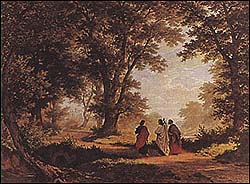
Sunday, March 30, 2008

ENCOUNTERING CHRIST ON THE ROAD TO EMMAUS--PART FIVE

Saving Faith Verses Religion

There are two types of Catholics, those that are truly Catholic Christians and those that are merely religious worshippers. In other words, there are those who practice religion for whatever reason and then there are those who posses true faith. And believe me when I say there is a real difference.

Religion is humanities creation; faith is Gods gift. A religious person comes to Mass to momentarily ease a guilty conscience and check off a Sunday obligation; while faith comes to Mass to see Christ Jesus. Religion sees Jesus as a meal ticket; faith sees Jesus as God. Religion searches for physical needs to be met by performing religious rituals; while faith on the other hand see rituals as a means of communing with God and receiving grace. Religion sees the signs, but not what the signs point to. But again faith sees Christ Jesus. The Church has this syndrome; worship, hymns, prayers, rituals, sacraments, sermons, creeds, benedictions, and even scripture. But what should be exciting becomes a common place where one cannot see beyond all the commotion in order to see the Word of God made flesh and dwelling among us. Religion is focused on right ritual while faith is focused on a right relationship with God. Religion is caught up in words while faith uses those same words to abide with the object of the words, Christ Jesus. Religion becomes common and mundane, but faith is always fresh and seeks to commune with God.

People who are religious do one of two things; they either wear their religion on the outside with pride and arrogance, like the Pharisees before them where everything was literal and outward in appearance giving the impression that their lives were in order. The other religious type is the one who hides it. They are the ones that shock you when you find out that they attend church. These people have not made Christ Jesus the center of their lives and they will die in their religion. In John 6, Jesus made it perfectly clear that unless we consume all of Him as the very substance of life, one will die of eternal starvation. When one sees Christ Jesus as the primary substance of life and ingests His life, death, and resurrection as we ingest food to live on, then one has faith, not religion. You see, religion cannot survive death, but faith in Christ Jesus can. Religion will not come out victorious on the other side of trials and tribulations, but faith in Christ is the ultimate victory in any and all circumstances. Religion will meet death with fear and trembling, but faith will cry out, “To live is as Christ, to die is gain!”

“The cup of blessing which we bless, is it not the communion of the blood of Christ? The bread which we break, is it not the communion of the body of Christ?” So asked St. Paul of the Corinthian Christians (1 Corinthians 10:16). It most certainly is! Yet the religious do not believe.

To those who merely attend Mass in order to check off another Sunday obligation cannot believe. For they, like countless other professing Christians who are not in full communion with the Church, see the elements as merely symbolic, meaningless pieces of bread and wine. But does their opinion mean they merely encounter the elements? In their places of worship it is true that the non-Catholic does indeed encounter nothing more than a mere symbol, but is that true within the confines Catholic Church? Certainly not! While non-Catholics and many professing Catholics fail to believe they are encountering the real Christ, His body, blood, soul and divinity under the appearance of bread and wine, doesn’t change the fact that they are indeed these things. They are merely carbon copies of their Pharisaic counterparts of old, who stood toe-to-toe, face-to-face, and nose-to-nose with Jesus, yet failed to accept or believe He was the Messiah.

Whoever comes forward to eat and drink from the Lords table without true faith and belief or fails to purify their soul of sin through the act of confession, reaps not blessing but condemnation. They are guilty of profaning the body and blood of the Lord. Those that do such a thing do not offer the first fruits of self-sacrifice after the manner in which Able offered the first fruits of his flock, become like Cain who offered something second rate and unacceptable to the Lord. In other words, they partake of the Lords table in an unworthy manner, thus eating and drinking judgment unto his or herself like their forefathers who partook unworthily in the early Church found themselves weak, sick, and some even died. Many are wrought with such things today for the very same reasons. The elements of bread and wine are truly the body and blood of the Lord. There is no symbolic intent in St. Paul’s words. In fact there is not a single instance recorded in all of scripture that testifies to anyone reaping the Lords judgment for having profaned a mere symbol (see 1 Corinthians 11:23-30). One cannot “drink the cup of the Lord and the cup of demons; you cannot partake of the Lord’s Table and the table of demons” (10:21).

Is all of this not true? Was there not one false disciple reclining at the table with the Lord at the Last Supper? There most certainly was! And until the proper moment in time had come he was unbeknownst by the other eleven. Judas Iscariot walked alongside the Lord for three years. He witnessed first hand all the miracles that Jesus worked among the sick, dieing, and even the dead and was even commissioned alongside the other eleven who were then sent out to preach the Gospel. He was with them when they received the power to cast out demons, heal the sick, cleanse lepers and raise the dead (see Matthew 10:5-14). Judas was even entrusted to be the keeper of the group’s finances. But despite all of that Jesus referred to him as being a devil (John 6:70) and the “son of perdition” (John 17:12), a term that St. Paul would later use to describe the Antichrist (2 Thessalonians 2:3). And he died after sharing in the bread and wine that Christ consecrated at the Last Supper.

Unfortunately there are many among us today, sitting at the Lord’s Table, who posses the same spirit that controlled the life of Judas Iscariot. But despite that fact and all the unbelief, the Eucharist is still in fact Christ Jesus coming to us veiled under the appearance of bread and wine.

So the question I propose is this: How do you partake of the meal that’s set before you? Do you come with mere religion checking off another Sunday obligation so that the bland taste of bread and the sweet taste of wine leave the taste of condemnation upon your tongue and then go home with one more religious quota satisfied which will soon be washed away with Sunday dinner? Or do you come in faith where the bland taste of the bread will become as sweet as milk and honey as your spirit is stirred reminding you of your sins and the Savior who took them unto Himself and suffered your punishment?

Have you ever wondered why Christ chose to utilized bread and wine to represent His body and blood? I know I did until the late Bishop Fulton Sheen eloquently explained the answer: “First of all, because no two substances in nature better symbolize unity than bread and wine. As bread is made from a multiplicity of grains of wheat, and wine is made from a multiplicity of grapes, so the many who believe are one in Christ. Second, no two substances in nature have to suffer more to become what they are than bread and wine. Wheat has to pass through the rigors of winter, be ground between the Calvary of a meal, and then subjected to purging fire before it can become bread. Grapes in their turn must be subjected to the Gethsemane of a wine press and have their life crushed from them to become wine. Thus do they symbolize the Passion and Sufferings of Christ, and the condition of Salvation, for our Lord said unless we die to ourselves we cannot live in Him. A third reason is that there are no two substances in nature, which have more traditionally nourished man than bread and wine. In bringing these elements to the altar, men are equivalently bringing themselves. When bread and wine are taken or consumed, they are changed into man’s body and blood. But when He took bread and wine, He changed them into Himself” (Life of Christ, Image Books, p.278).

In order for all of us to avoid the trap of falling into mere mundane religion, we need to heed the words of St. Francis De Sales: “From the beginning until the priest goes up to the altar make your preparation with him. This consists in placing yourself in the presence of God, recognizing your unworthiness, and asking pardon for your sins (and mean it from the depths of your heart). (2) From the time he goes up to the altar until the Gospel consider our Lord’s coming and His life in this world by a simple, general consideration. (3) From the Gospel until after the Creed consider our Saviors preaching and affirm that you are resolved to live and die faithful and obedient to His holy word and in union with the holy Catholic Church. (4) From the Gospel to the Our Father apply your heart to the mysteries of the Passion and Death of our Redeemer. They are actually and essentially represented in this Holy Sacrifice. Together with the priest and the rest of the people you will offer them to God the Father for His honor and for your own salvation. (5) From the Our Father to the communion strive to excite a thousand desires in your heart and ardently wish to be joined and united forever to our Savior in everlasting love. (6) From the communion to the end of Mass give thanks to Jesus Christ for His incarnation, life, passion, and death, and for the love He manifests in this Holy Sacrifice. Implore Him always to be merciful to you, your parents, friends, and the whole Church. Humble yourself with all your heart and devoutly receive the blessing our Lord gives you through the ministry of His minister” (Introduction To The Devout Life, Image Books, p. 104-105).

A true relationship with Christ is evidenced in the breaking of the bread and should result in a changed life and behavior. It should make us sensitive to our sins, our faults, and failures. It should make us see them in the light of the tremendous price Christ paid to secure our redemption. As we gather together with our brothers and sisters to celebrate the Eucharistic meal, we should be conscience of our oneness not only with those who partake of the elements with us, but with Christ Himself. The Eucharist is a family meal, and the Lord of the family desires that His children love one another and care for one another. That we should be one in Christ and that oneness should be evident in everything we say or do during Mass and after Mass when we step back out into the world even if others fail to recognize us as such.

I can imagine Cleopas and his friend standing in amazement, perhaps embracing in great joy, asking each other, “Were not our hearts burning within us while He talked with us on the road and opened the scriptures to us?” Their world had finally come together again. With their hearts still ablaze they set off at once for Jerusalem. It matter not that darkness had fallen across the land and traveling at night was extremely dangerous, the joy that Jesus had placed in their hearts through the hearing of His words and the breaking of bread made the danger seem trivial. They were determined to share with the other disciples what had transpired on the road to Emmaus. And that’s the type of attitude that we should have.

May The Peace Of Christ Be With You!

Saturday, March 29, 2008

ENCONTERING CHRIST ON THE ROAD TO EMMAUS—PART FOUR

The Heart Burning Experience

As the two-hour journey from Jerusalem to Emmaus was coming to a close, they approached the village at which time Jesus acted as if He was continuing on further. God has given the world the greatest and most perilous gift that one can receive—the gift of free will. This gift that has been bestowed upon each of us to either invite Christ into our hearts or allow Him to pass on is the same gift that is offered in the Book of Revelation where we find the Lord saying, “Those to whom I love I rebuke and discipline…here I am! I stand at the door and knock. If anyone hears My voice and opens the door, I will come in and eat with him, and he with Me” (3:19-20).

This was the very situation in the Emmaus story. Jesus had been knocking on the two disciples hearts throughout the journey and now as He acted as if He was going further the two men needed to make a decision to either invite this stranger to stay with them or to allow Him to continue on His way. They elected to invite Him to stay.

The three entered a dwelling where a basic meal was quickly prepared. As the meal was placed upon the table the moment came for Jesus to disclose His true identity. How did He do it? “He took bread, gave thanks, broke it and began to give it to them.” It was through the action of the breaking of the bread that their eyes were opened to the stranger’s true identity. It was an action they had no doubt seen before. They no doubt saw His hands—that they were different from when He had last broken bread before their eyes. They were the nail-pierced hands of the Savior of the world. But it was in the act of the breaking of the bread that resulted in their knowing Him in an instant. And then in another instant, He was gone.

Each time we come to the Lords table, we witness the intimate act of the breaking of the bread. It is through this simple act that God has chosen to open our eyes—the eyes of our mind and the eyes of our heart in order that we may understand what He has done for all of us.

Why did the two disciples not recognize Jesus on the road? Had they not heard Him teach, had they not witnessed the miracles worked by His hands, and had they not heard Him tell them all that as the Messiah He would suffer, die and on the third day rise again? They had indeed. But the two disciples could not recognize Jesus because they had the wrong expectations concerning the Messiah. They had human expectations for fulfilling a divine plan. They had expected Jesus would deliver Israel from the hands of her oppressors as a military and political Messiah. So Jesus had to come to them as a stranger in order to fill in the gaps of their misconceptions.

If the Lords first disciples, who were first hand witnesses, needed to observe the Eucharist in order to recognize the Savior of the world then how much more do we need it? We need it not only to open our eyes so we too can recognize Christ but also to serve as a reminder of what Christ Jesus endured to pay for our sins lest we become so preoccupied with our lives and activities that we fail to commune with Him. The Eucharist is a touching memorial that should fill our hearts with gratitude as we partake of it with other believers. It should bring to our minds those scenes of our Lords suffering portrayed in the Gospels. Christ desires that we remember how He died. He desires that we remember because everything we have as Catholic Christians centers in His death. However, this memorial is not simply the recalling of historical facts.

To Be Continued...

ENCOUNTERING CHRIST ON THE ROAD TO EMMAUS--PART THREE

The Relevance Of Scripture

As the two disciples spoke of what transpired on the cross, Jesus took hold of their bewilderment and sorrow and gave them a heart filling experience. How? By pointing them unto God’s self-revelation in the scriptures. Luke tells us, “Beginning with Moses and all the prophets, Jesus explained to them what was said in all the scriptures concerning Himself.”

Jesus gave the Emmaus travelers the greatest Old Testament exposition in history. Through His words the shadows and symbols of the Old Testament revelation began to come together. He reminded them that back at the fall of mankind, the apparently victorious Satan, in the form of a serpent, was told that the seed, the offspring of a woman “will crush your head, and you will strike His heel” (Genesis 3:15). And so the story was foretold of the cosmic struggle between life and death, of the pattern of death and resurrection according to Old Testament revelation. It was clearly visible in the life of Abraham when he was willing to sacrifice his only son Isaac, only to get him back again. In the preservation of Joseph so he could become the benefactor of his brothers who tried to destroy him. In the Exodus of the Israelites from Egypt after having been saved from the angel of death through the sign of the blood of the Passover lamb. Jesus recalled His own teaching of how the Israelites escaped physical death in the wilderness from a plague of serpents when they looked trustingly to a great bronze serpent which Moses raised on a pole, pointing out that He too would be lifted up on the cross, “that everyone who believes in Him may have eternal life in Him” (John 3:15).

Jesus no doubt took the now speechless disciples through the Suffering Servant of Jehovah passages in Isaiah and recounted how the nation of Israel was taken into exile and brought back again to rebuild Jerusalem as a symbol of the greater redemption through personal salvation through faith in Him. Throughout His discourse Jesus offered proof that He had fulfilled that, which had been prophesied over the centuries. That the Old Testament anticipations of His passion and triumph of life over death was proof that He was indeed the long awaited Messiah.

The two disciples couldn’t have possibly expected that the sharing of their problem with the stranger on the road to Emmaus would bring them toward a solution. But there was more to it than that. Christ wasn’t merely walking beside them to help them find a solution—He was in the problem itself. Jesus asked His two listeners, “Did not the Christ have to suffer these things?”

The problem for the disciples as it is with many in our time was making sense of the cross, how to accept it. Jesus helped them through that by showing them how the cross itself was the creative act of God. St. Paul would later write that, “God was in Christ reconciling the world unto Himself, not counting men’s sins against them” (2 Corinthians 5:19). The cross of shame and suffering had become the Cross of Redemption for all who would come to Christ in repentance and faith.

The most vital instrument used in the proclamation of the Gospel and evangelization is the use of scripture. As apologist Jeff Cavins once stated, “Catholics must proclaim the Word—what Christ says about our situation, what He is offering us, what He says about the Church and the beauty of the Church.” The underlying problem is however, “Many Catholics don’t know the bible. They don’t know it enough to talk about it. What kind of position does that put one in if we are supposed to be out there changing the world—proclaiming the good news?”

Another problem that arises over the scriptures is the fact that many Catholics that do read and know scripture have not studied apart from proving Catholic doctrine. They have not read scripture in the sense that Pope John Paul II recommended, and that is to read it and allow the Holy Spirit to speak to ones heart. To see what the Holy Spirit has to say to us as individuals.

The written Word of God is the one place we can definitely hear the voice of God. Therefore it is imperative that we pay close attention to the readings at Mass; that we give them our undivided attention. For it is through the proclamation of the Gospel reading that Jesus begins to intrude into our lives, probing our thoughts, for the purpose of blessing us and helping us grow. What matters here is how we respond. Do we, like the two disciples welcome His initiative and let Him minister to us? Do we want Him to keep talking and explaining what previously baffled us? Or do we merely desire that the Gospel proclamation be over because the things He reveals are too uncomfortable as He encroaches into our conscience?

Jesus rebuked Cleopas and his companion when He said, “How foolish you are, and how slow of heart to believe all that the prophets have spoken.” Perhaps the key word is “all.” It wasn’t that they hadn’t read or heard all that had been proclaimed by the prophets of old, but perhaps they had read or heard selectively like so many do today. The passages that spoke of a suffering servant didn’t fit with their expectations of the Messiah, just as many today cannot accept or follow a Messiah that calls us to suffering. Many have a tendency to skip over or ignore such biblical passages that reference to such a thing. If one truly opens his or her mind, spirit, and soul when given an exposition from the scriptures they will react positively, and in fact will want more.


To Be Continued…

Friday, March 28, 2008

ENCONTERING CHRIST ON THE ROAD TO EMMAUS—PART TWO

A HEART FILLING EXPERIENCE

As the three men walked along Jesus asked the two disciples, “What are you discussing together as you walked along?” Quickly the men realized they were amongst someone who was willing to listen to their sorrows and troubles so they poured out their sad story.

How wonderfully kind and compassionate is our Lord. He could have very well become angry with these two men for their lack of faith in Him. After all hadn’t He said, “Unless a seed dies, it abides alone, but if it dies it bears much fruit?” (John 12:24). But no, Jesus doesn’t berate them but rather as someone once stated, “In His infinite courtesy, Jesus remembered the frailty of over-strained nerves and bewildered minds and came, not too suddenly or overwhelming upon them, but with gracious signs and tokens, and messages from one to the other.”

Cleopas (one of the two disciples) expressed surprise at the stranger’s inquiry so he asked: “Are you the only one living in Jerusalem who doesn’t know the things that have happened there in these days?” Despite the note of incredulity in the voice of Cleopas, Jesus continues patiently and innocently asks, “What things?” To which they eagerly replied, “About Jesus of Nazareth.”

The two men then told the stranger that this Jesus “was a prophet, powerful in the word and deed before God and all the people.” Notice the use of the past tense, which strongly implies that He wasn’t relevant to the present or otherwise they wouldn’t have been in their downcast state of mind. Their experience concerning Jesus was in the past. The cross-had taken Him from them, and their minds hadn’t yet made sense of the changed situation, or adjusted to it. At the time the cross was just a great negative to them.

We’ve all heard exciting stories of what Jesus has done in the past—but what about the present? Too often we get fixated on all the bad that has occurred in our lives to the point that we forget that all of that is history. We must ask ourselves if Jesus is a present, bright reality in our lives today or is He something in the past? Do we recognize what He is doing in our lives; that he is walking beside or with us? Or is He just another stranger on the road?

Life has many distractions—hard work, routine, tiredness, and at times ill health, that can grind us down to the point where we carry on mechanically, never lifting our eyes or minds from the dust of the earthly road we travel. We thus become unaware of the glory and strength of His presence with us. When that occurs life then looses its meaning and leaves us washed out. But this story gives us hope.

Jesus is just as real among us today as He was 2,000 years ago on the road to Emmaus. He is the “unseen stranger” walking with us, listening to us, and if we are willing to listen for His voice, He will reveal Himself to us. He may not reveal Himself to us today as He did in the past. He won’t appear in a burning bush as He did with Moses or an audible voice in the middle of the night, as was the case with Samuel. We aren’t likely to receive a physical heavenly vision, as was the case with Isaiah. But nevertheless He still speaks to those who seek Him. Jesus speaks in the silence of the waiting spirit, forever impressing His will and call upon those who are willing to listen.

The voice of the Holy Spirit speaks to the inner shrine of the heart and it’s the same voice that called Peter, Andrew, James and John away from their fishing nets, Matthew from his tax booth, Zacchaeus out of a tree, and called out from heaven through a blinding light that knocked Paul from his horse. It’s the voice of Christ Himself perpetually calling all of us to “Come out from among them and be separate, says the Lord. Do not touch what is unclean, and I will receive you. I will be a Father to you, and you shall be My sons and daughters, says the Lord God Almighty” (Isaiah 52:11; Ezekiel 20:34, 41; 2 Samuel 7:14; 2 Corinthians 6:17-18).

Have you not heard His voice? If you profess to serve Christ and His Church, it is strange if you have not.


To Be Continued…

Saturday, March 22, 2008

ENCOUNTERING CHRIST ON THE ROAD TO EMMAUS—PART ONE

As I look toward the cross alongside thousands of others, I begin to notice that the crowds are breaking up and leaving. After I take one more glance at the cross of Christ I turn to leave but I am immediately confronted with two roads. I notice many are choosing the road to the left, but only a few are choosing the road to the right. As I approach these two roads I notice two men. The first one is dead and is lying beside the road to the left. But the other is alive and is pointing to the road on my right. To my amazement many are asking the dead man for directions. I thought to myself, “Why would anyone ask a dead man for directions when there is one who is alive?”

Every day we make decisions in life simply because we are creatures of variety. We choose what time we get up, what we wear, eat, and what we will do throughout the day. In fact there are many decisions that beg for our attention right now, but there is only one choice that you and I must consciously choose before it’s too late. And that’s to walk the “narrow road.” It is the road to the right, the road to righteous life. This road is one of decision, discipline, and desire. And like the road to Emmaus it will lead us to an encounter with Jesus, the one who is alive.


ON THE ROAD TO EMMAUS:

It was late in the afternoon of the day of resurrection when two disciples were on their way to Emmaus, a little town about seven miles from Jerusalem. The two disciples were discouraged and depressed. The Master they had revered, loved, and followed, had been horribly put to death. A cruel death of the most degrading kind—crucifixion!

Only a week before, on Palm Sunday, the disciple’s hopes had risen to fever pitch when the excited crowds had hailed their Master as the long awaited-deliverer that would set them free from Roman occupation. But now their Master lay dead in a sealed tomb and their hopes were dashed; the dream was over.

Have you ever noticed that some of the saddest words in our language begin with the letter D? For example, there is disappointment, doubt, delusion, defeat, despair, and death. All of which can damper our hopes. Human hope is a fragile thing and when it withers its difficult to revive. Hopelessness is a disease of the human spirit that is desperately hard to cure. When you see someone you love and care for overtaken by illness, which goes on, and on, despair sets in. It almost becomes impossible to hope for recovery, to even be afraid to hope because of not being able to cope with another letdown.

Each of us have no doubt at times felt blind, distant, and even given up all hope. In fact there have probably even been times when we prayed and prayed and received absolutely no help, which resulted in our losing all hope. There were probably even times when we have prayed and our problems seemed to have only worsened. Maybe it was when we prayed for healing for another or ourselves but the sickness only got worse. During these times of despair doesn’t mean that God has left us alone. We only believe that He has since the problems in life have a way of blurring our vision, our understanding, our faith, and our hope. It makes us want to run away from our difficulties rather than stand and face them. But how fortunate we are that we have a God who not only comes looking for us, but also draws near and travels with us each step of the way and helps us to be able to clearly see again. Remember this: God will never abandon His children, but often His children abandon Him over disbelief.

There wasn’t really a reason for the two disciples to be in the state of mind that they were in other than disbelief. For you see, even though they had received the news of the morning, that Mary had found the grave of Jesus empty and had heard the claims of some of the other women that they had seen angels and had even met the risen Jesus, they did not believe those reports.

God accomplishes His greatest work through us by allowing our hopes and dreams to die, only to bring them back again in rather surprising and unique ways. Job lost his family and fortune, but they were eventually restored many times over. God blessed Abraham and Sarah with a son long after nature would have made that impossible. And the hopes of these two disciples had been dashed when Jesus died upon the cross. They did not realize at the time that the cross and all its horrors were a part of Gods sovereign plan to pave the way of salvation for all of humanity.

Many of us may not like our current surroundings or situations, or even the direction that society appears to be going or all the ungodliness that seems to plague the Church, but remember not all is lost. We merely need to wait upon the Lord to redeem our situations and restore our hope. We don’t need to focus on the negative when there are many wonderful things transpiring within our own lives and the Church that overrides all the negative aspects. We just need to stop long enough to take a serious look around.

As the weary disciples made their weary way toward Emmaus a stranger fell in alongside them. What had begun as a very depressing trip soon turned into one of the most wonderful walks in human history! We know this because the stranger was the risen Jesus. But somehow in the beginning they did not recognize Him. In fact Luke tells us “they were kept from recognizing Him.” It wasn’t by accident that they didn’t recognize who He was. No, they weren’t allowed to recognize Jesus for a reason. And the reason was so that they might be in the same position as we are 2,000 years later.

Many times we do not recognize Jesus when He suddenly appears in our midst. Sometimes He appears to us as a stranger who speaks the right words we need to hear for whatever ails us. Other times He may come to us in the form of a beggar, someone who’s hungry, or some other needy person. He may even come to us, as someone in trouble, someone whose marriage just went south, or someone who has lost a child, a spouse, or some other loved one. It may be that He comes to us through someone in need of friendship, a shoulder to cry on, or someone seeking Himself. How we respond during those times will determine our level of commitment unto Him. Do we dare deafen our ears and look the other way, forgetting the times He met our needs? Or do we respond as He did when He met the two blind men on the road to Jericho? These particular blind beggar’s cried out unto Him, “Have mercy on us, O Lord, Son of David!” But the people commanded them to be silent. But that didn’t stop them they merely cried louder and more intense until the Master commanded they be brought before Him. Then He asked one very simple question, “What do you want Me to do for you?” To which they responded, “Lord, that our eyes may be opened” (Matthew 20:29-33).

We may be the only contact that many will ever have with Christ Jesus. I once heard it said, “There are five Gospels, Matthew, Mark, Luke, John, and us. Many will never read the first four, but all will read the last one.” Christ Jesus didn’t commission us to leave this world, or to sit idle in it, but to disciple it.

For far too long Christianity in America has sat idle living in her own little world. For decades the majority of professing Christians have been going in the direction they have desired instead of going in the direction that God desires. They have distorted the scriptures and cheapened the gospel in such a way that humanity has become riddled with confusion, which is why 1.37 million babies are murdered annually in America; why 40 million Americans indulge in Internet pornography; why divorce is rampant and 50 to 70% of all married people will commit adultery this year. It is also why 10,000 people will be murdered this year alone of which over 5,000 will be between the ages of 10 and 24. And it is also why over 30,000 people will see life as no longer worth living and commit suicide and why Americans are confused about the sanctity and institution of marriage being only between a man and a woman.

To barrow the words of Fr. Tom Forrest, I must also say: “If there were ever a time when sinners needed conversion, if there were ever a time when captives needed to be set free and mountains of pain and depression removed, if there were ever a time when the human race needed sanctification and salvation, if there were ever a time when the whole world needed to hear and follow Christ’s teachings on love, mercy, and forgiveness, that time is now!” Whose cry are you willing to hear? Whose eyes are you willing to open?

To Be Continued…

Sunday, March 16, 2008

Escaping The Outer Darkness

Yesterday I went to confession at a different parish, one that's a little closer to home. The line was quite lengthy, but with several priests hearing confessions it moved quite quickly. Now it doesn't matter whether I make my confession face-to-face or in the box. It just happened to be the box when it came to be my turn. When I first entered there was light to show the way, but as I knelt the tiny room became engulfed in darkness.


Now there was nothing new in that experience with the exception of the fact that I noticed it was much darker than the confessional at my own parish. It was so dark I couldn't see my hand in front of my eyes. It was a strange feeling to be in that type of darkness. But I thought how appropriate. It made me think how vital it is that we make regular confessions, more than once or twice a year. For it is from the outer darkness, the land of wailing and nashing of teeth that confession saves us from. Without it we would parish.


The Church teaches that Christ calls us “to conversion and penance, like that of the prophets before Him, His call does not aim at outward works, “sackcloth and ashes,” fasting and mortification, but at the conversion of the heart, interior conversion. Without this, such penances remain sterile and false; however conversion urges expression in visible signs, gestures and works of penance (see Joel 2:12-13; Isaiah 1:16-17; Matthew 6:1-6, 16-18).


Interior repentance is a radical reorientation of our whole life, a return, a conversion unto God with our whole heart. It means an end to all intentional sin, a turning away from evil, with repugnance toward the evil actions we have been committing. But at the same time it entails that we desire a resolution to changing our life with hope in Gods mercy and trust in the help of His grace. This conversion of heart is accompanied by a salutary pain and sadness which the Father’s called animi cruciatus (affliction of the spirit) and compunctio cordis (repentance of the heart)” (CCC 1430-31).


Interior penance begins a life long journey of repentance and conversion. But too often we have a tendency to view that conversion in a manner that prevents one from excelling in the life of Christ. It is right to view it as something spread across our entire lives, but it isn’t right to view it as something that is in the distant future. Far too many look upon conversion in such a way that it leaves them in the same spot and in the same frame of mind, one that prevents any forward movement. Thus they begin to resemble more of a stagnating, mosquito infested pool of water, than one that continuously moves forward toward a Christ-like life. Repentance and conversion must begin with a frame of mind that seeks to make a true confession before the agents of God. Interior penance requires… “The sinner to endure all things willingly, be contrite of heart, confess with the lips, and practice complete humility and fruitful satisfaction. Among the penitents acts contrition must occupy first place. Contrition is “sorrow of the soul and detestation for the sin committed, together with the resolution not to sin again” (CCC 1450-51). We must be willing to hear the voice of Christ when He said to the woman caught in adultery, “Go and sin no more” (John 8:11). And to the sick man He found by the Bethesda pool, “See, you have been made well. Sin no more, lest a worse thing come upon you” (John 5:14).


The sacrament of reconciliation is not to be looked upon or used as a revolving door to momentarily relieve the conscience of guilt only to return and repeat the same sins again in habitual form. There is no forgiveness if there is no true sorrow and remorse for the sins one has committed. We all have sins that we struggle with. In fact we must face the fact that we may struggle with or be tempted to commit those sins until the day we die. But its how we look upon those times of temptation to a particular sin (or sins) that counts.


When temptation affords itself and we flee crying out to the Lord for strength, then we are on the right track. However, when those temptations rear their ugly head and we gaze upon them and embrace them as we would a long lost friend, then we are in trouble! Reconciling With God isn’t about keeping rules. It’s about freedom and new life. It’s about a heart filling experience. What Jesus did for His friend Lazarus He desires to do for you and I and that’s to give us new life.


In John 11, we find Jesus and His disciples traveling to Bethany near Jerusalem. Word had been sent that His friend Lazarus was sick and near death. Upon their arrival in Bethany He was met by Martha the sister of Lazarus. She was distraught over her brother’s death and said to Jesus, “Lord, if you had been here, my brother would not have died. But even now I know that whatever you ask of God, God will give you.” Jesus said unto her, “Your brother will rise again.”


Now Martha knew that on the day of resurrection her brother would live. But Jesus wasn’t referring to the future but to the present. So He said unto her, “I am the resurrection and the life. He who believes in Me, though he may die, he shall live. And whoever lives and believes in Me shall never die.” Then Jesus asked the million-dollar question, “Do you believe this?” Many say they believe. But if they possessed true belief they would be willing to come forth out of the grave of sin to new everlasting life.

Thursday, March 13, 2008

Where The Grass is Always the Greenest

There are many things that I have learned over the past fifty years, the greatest being that the secret to our happiness on this earth is to serve God with the best of our ability and to do so with a thankful heart. For you see, far too often we neglect to become thankful for what we have because were too busy concentrating on what we don’t have or becoming envious of what others do have. In other words, believing that the grass is greener on the other side.When we believe “that the grass is greener on the other side,” we are only seeing what lies on the surface. Sometimes those whom we become envious of may appaer to have more money, a bigger or nicer house, or even a newer car. But what we fail to realize is that their lives are not perfect.


In many instances what we perceive to be real grass may in reality only be artificial turf, which is a man-made surface manufactured from synthetic materials to look like natural grass. The grass may look real but remember flowers cant grow in synthetic grass.When we become overly focused on someone elses grass we are ignoring all the negative aspects of someones life while downplaying everything positive in our own. We cant see whats good about our own grass because we are fixated on the weeds.


Now nobody likes weeds. Weeds are the bane of our existence. We do nothing, and weeds come up. We spray like crazy, and they come back. In fact weeds grow where other plants won’t because they are very sneaky. But regardless of how many weeds have sprang up in our field of life we only need to pull them up one more time and then get out the lawn seed, sprinkle liberally, and then use that forgotten watering can.


Believe it or not, there is a direct link between the choices we make and the things that happen to us. When we becomes willing to accept that, our outlook on life will become different. It’s called reaching a level of maturity. So the next time you're tempted to look at anothers grass, keep in mind that grass is always the greenest where it’s watered. And the best way to water our grass is to ask God to “grant us the serenity to accept the things we cannot change and the courage to change the things we can, and the wisdom to know the difference!”